


When The Anxious Generation was published in March 2024, we were flooded with questions from parents, teachers, journalists, researchers, and policymakers: What are the impacts of watching hours of short-form videos every day? How much screen time is harmful for infants? Does educational technology actually improve student learning? How will AI reshape childhood?
We knew that answering these questions would be essential to understanding the full scope and impact of the “Great Rewiring of Childhood” — the mass migration of social life, education, and leisure time onto digital platforms in the early 2010s. To answer such questions, we began building a research group at NYU Stern School of Business. That group has now grown into the Tech & Society Lab, a team of 10 researchers studying how rapidly changing technologies are reshaping childhood, human flourishing, and our democratic institutions.
Today, we are excited to launch our new website and share its resources with readers at After Babel: TechAndSocietyLab.org.

The site brings together all of our research, including our working papers, academic publications, and ongoing projects. You can also meet the amazing members of our team and find a list of the questions we are currently working on answering. Our aim is to ensure that this site and repository of research will be useful for academics as well as parents, educators, journalists, and policymakers.
The Lab organizes its work across eight broad research areas, each with a dedicated page where you can explore related publications, essays, and ongoing projects. Most areas are oriented around the impacts of different digital technologies on childhood and adolescence.
Below, we show you what you can find on the site, summarize some of our biggest findings to date, and explain how our work informs the recently launched TAG Movement.
Our Publications, All in One Place
On our website, you can find the full list of our academic publications and popular press articles. These include academic publications such as our feature article for the 2026 World Happiness Report on the many lines of evidence showing that social media is not safe for teens; our 2026 paper in JAMA Pediatrics on measuring online harms across applications; our publication in Clinical Psychological Science responding to three recent papers by professors Andrew Przybylski and Matti Vuorre; and our meta-analysis on the social media reduction experiments done in collaboration with Gary Goldfield and Marcus Lopes.

The archive also includes some of the Lab’s widely read After Babel posts, along with popular press essays, such as our New York Times series on the testimonial evidence of Gen Z and parents on how they perceive the impacts of social media; our Atlantic essay on the ways that the research on social media’s impacts on LGBTQ teens has been widely misunderstood; and our recent TIME piece on the efficacy of Australia’s social media age minimum.
Collaborative Review Docs
You can also find our “collaborative review” Google documents, in which we organize the evidence on key research topics and gather feedback from other researchers. We create a review document each time we explore a new topic, from mental health trends in East Asia to the effects of digital technology on older adults. These documents are not meta-analyses or systemic reviews; they are just our attempt to find out what’s out there, on all sides, as a way to begin studying a new topic. We have done this since 2019 and found this strategy to be very helpful for developing a sense of a research literature that is fast changing, as is the case with all things tech-related.
These include (not exhaustive):
Adolescent Mood Disorders Since 2010: A Collaborative Review
Social Media and Political Dysfunction: A Collaborative Review
Alternative Hypotheses to the Adolescent Mental Illness Crisis: A Collaborative Review
What Is Happening to Youth in the Anglosphere? A Collaborative Review
Nordic Adolescent Mood Disorders Since 2010: A Collaborative Review
We invite academic researchers to request commenting access for any of the docs and then add studies, comments, and objections. You can find them all here.
Our Contributions and Impact
While we’ve just formally launched our website and have recently grown the team, the Tech & Society Lab has been a major contributor to the research and debate around technology’s impacts on kids, and on society as a whole. Here are some of our most significant contributions. (After Babel readers will be familiar with a lot of this work, as we often publish it on Substack.)
1. Social Media and Mental Health

Does social media cause depression and anxiety? What was happening to adolescent mental health across many nations? These were the central research questions from 2017, when Jon was writing The Coddling of the American Mind, all the way through 2024, when Jon and Zach published The Anxious Generation. Since 2024, we have engaged in debate with other researchers, which has sharpened our understanding of different kinds of evidence and outcomes.
Here are a few of the most important things we have learned.
There are many lines of evidence showing that social media is harming youth mental health
In Chapter 3 of the 2026 World Happiness Report, we synthesize seven lines of evidence into a comprehensive case that social media is not safe for teens, and is harming adolescents’ mental health at a scale large enough to cause changes at the population level.
These include:
Surveys of young people, showing that young people feel a lot of regret and little gratitude toward the major social media platforms many use daily
Surveys of parents, teachers, and clinicians, in which all four groups attest to social media negatively affecting young people’s mental health
The contents of internal documents from social media companies, including those in which researchers speak frankly about social media’s mental health harms
Findings from cross-sectional studies, which show that social media use is correlated with symptoms of mental illness
Findings from longitudinal studies, which show that social media use at one time predicts increased symptoms of mental illness later on
Findings from social media reduction experiments, which show that those who reduce or stop their social media use see their mental health improve, relative to those who do not; and
Findings from natural experiments, which show that greater access to social media or high-speed broadband predicts rising rates of mental illness among large populations.
The Tech & Society Lab has contributed research in several of these lines of evidence. Two of our most important papers on the topic of social media and mental health are a review of natural experiments and a meta-analysis of social media reduction experiments. In the meta-analysis, we found that interventions to stop or reduce social media use for one to three weeks led to significant reductions in symptoms of depression and anxiety (on the order of g = 0.21 and g = 0.27, respectively — comparable to the efficacy of other youth mental health interventions, such as school-based depression and anxiety prevention programs or youth psychotherapy).
Social media companies themselves knew that it was harming kids
We have also learned, from documents disclosed in recent litigation, that Meta, as well as other prominent social media companies, were well aware of the risks their products posed to young people’s mental health and wellbeing.
In Meta’s case, our researchers Bennett Sippel and Nikolaus Greb compiled and summarized 35 different studies from internal researchers that speak to the mental health risks of Meta products. You can explore them at metasinternalresearch.org.
It is not just Meta, however. Similar revelations have emerged in litigation against both Snapchat and TikTok, whose employees have privately acknowledged large-scale harm to adolescent mental health from their products, including harms related to addictive, compulsive, and problematic use, sextortion and sexual abuse, cyberbullying, body dysmorphia, and exposure to content related to self-harm and eating disorders. We have compiled evidence of internal discussion of these harms, as relates to both Snapchat and TikTok, here on After Babel.
Some studies find “small” or no effects because of two methodological blind spots
We have also investigated why some researchers come to very different conclusions, including those who say that the effect of social media on mental health is tiny or non-existent.
To explain the discrepancies among researchers, we (Haidt and Rausch, in press) identified two common practices in social media research that lead to the understatement of social media’s risks. The first is relying heavily on correlation coefficients while omitting risk ratios, which are often used in public health and can better reveal harms that are often concentrated among heavy users. The second is what we call “improper blending”: combining different exposures, outcomes, or populations, and reporting only the aggregate result. Doing so can obscure larger effects concentrated in particular groups, such as depressive symptoms among adolescent girls who are heavy users of social media.
In two additional papers, Rausch and Haidt (in press) and Sigaud et al. (2026), we identify methodological problems or limitations in four studies that have been used to claim that social media or other digital technologies have small or insignificant effects on adolescent mental health.
Taken together, we believe the evidence of large-scale harm to adolescents from social media use is now very strong, particularly with respect to depression and anxiety symptoms among girls.
We have now also created a new page that brings much of this evidence together in one place: techandsocietylab.org/causality. To keep up with our new research projects on this topic, go to the smartphones and social media page.
2. The Impacts of Short-Form Video

Much of what we know about social media and young people comes from an era when platforms were built around friends, followers, and photos. In fact, they used to be known as “social networking systems.” But teens now spend increasing amounts of time watching highly engaging streams of short-form videos, posted mostly not by their friends or family, but by people they have never met and probably never will.
TikTok was built entirely around this model: ignore the social network, just grab eyeballs. Its commercial success led other platforms to follow: Instagram launched Reels in 2020, and YouTube launched Shorts in 2021. More than half of Instagram’s ads are now short-form videos. U.S. teens now spend an average of about 1.5 hours a day on TikTok alone, not counting the time they spend watching Instagram Reels or YouTube Shorts.
What does spending hours each day watching these kinds of videos do to attention, memory, self-control, and mental health, and in particular, to developing brains? Research in this area is starting to grow, and so far it is concerning.
Multiple papers that synthesize findings across many studies consistently link heavier short-form video use to worse cognitive outcomes, including poorer attention, weaker self-control and working memory, and a greater tendency toward compulsive or problematic use. The associations are sizable. The largest meta-analysis we are aware of (Nguyen et al., 2025) finds correlations of r = 0.30 to 0.40 with cognitive outcomes. Links to depression and anxiety also appear to be roughly twice as strong as those found for social media use in general.
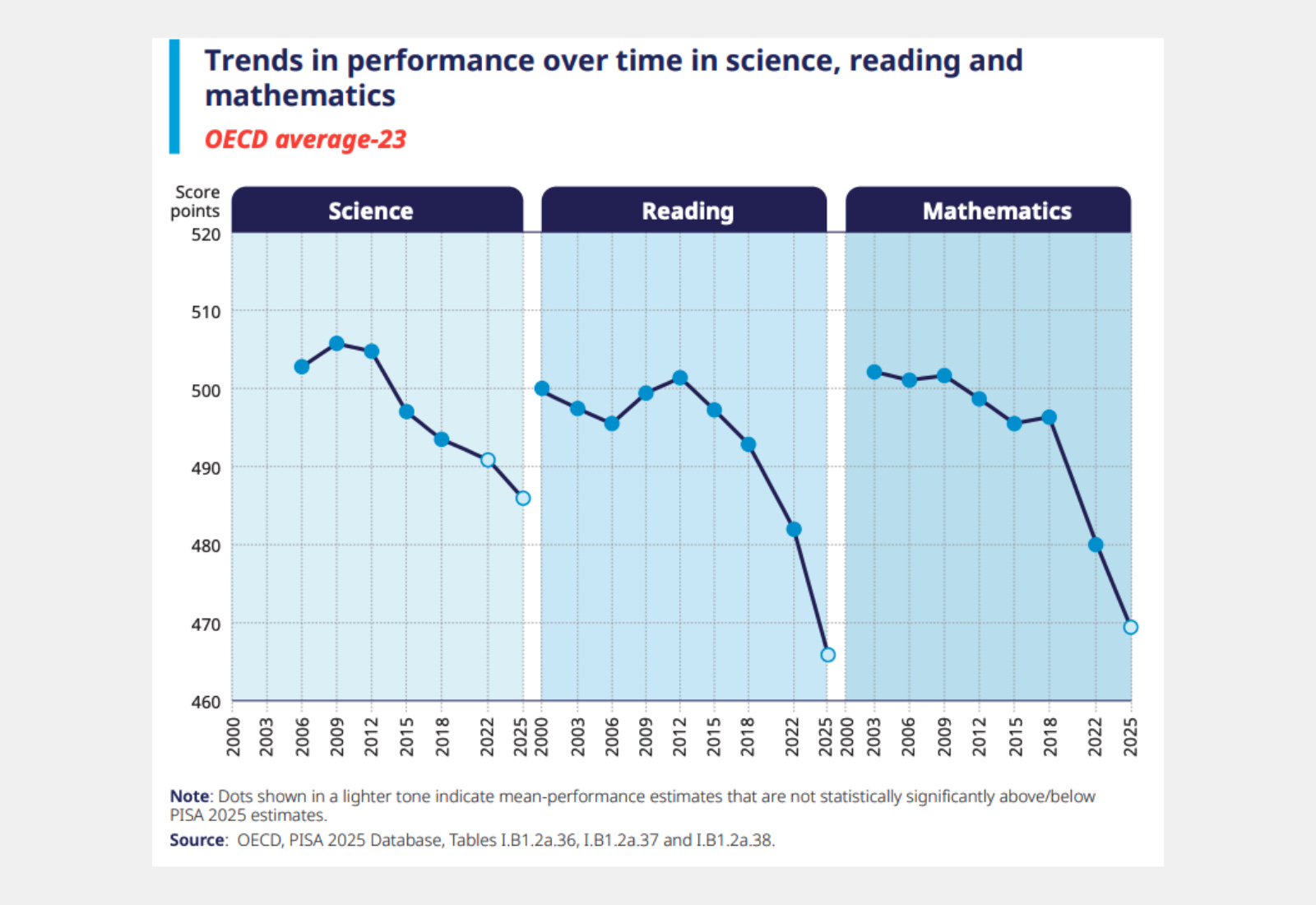
These findings are especially alarming in light of new evidence from PISA, the international triennial survey of student academic performance, showing the plummeting of student performance, especially in reading and math. The authors of the report themselves suggest that the rise of short-form video may be a key contributor.
To keep pace with the evidence on how short-form videos affect brain functioning, mental health, and wellbeing, we have created a live public document that catalogues the research on this topic and summarizes the findings. We are also working to summarize this evidence more systematically for an academic audience.
To follow our work on this topic, visit our smartphones and social media page.
3. Online Harm Prevalence Across Apps

One unexpected problem we have encountered is that many of the harms parents worry most about are measured poorly and inconsistently. Researchers themselves do not have a shared understanding of the prevalence of different harms to kids across apps and whether those harms are changing over time.
For example, we lack a shared understanding of how many young people experience unwanted sexual solicitations, sextortion, or cyberbullying, or encounter troublesome content promoting self-harm or eating disorders. We also know relatively little about how these experiences are distributed across platforms, or how effective companies’ tools are at preventing and mitigating them.
Several organizations, including Pew Research Center and Thorn, have surveyed young people about their experiences online. Most surveys, however, capture only part of the picture. Some ask about a single harm, or a small number of harms, across many apps. Others ask about multiple harms, but only on a smaller subset of apps. Few track these outcomes consistently over time. Surveys also differ in their wording and the ages of the young people they study.
As a result, it is remarkably difficult to compare rates of harm across platforms or track whether they are getting better or worse over time. No single source currently provides a comprehensive picture of what harms young people are experiencing and where they are occurring.
To address this gap, we are collaborating with researchers at the Stanford Center for Digital Health, the Stanford Tech Impact and Policy Center, and the University of Southern California to build a survey that draws on — and standardizes across — many existing surveys. Our goal is to create an instrument that measures a wide range of harms across the platforms teens use, allowing researchers to make meaningful comparisons across platforms and over time, and enabling regulators to see which platforms are making meaningful changes to reduce harm.
To date, we have published results from a pilot study in JAMA Pediatrics, which will help shape our final survey instrument. We will also soon launch a website that catalogs existing surveys on youth online harm measurement, which we continue to draw on as we build our final instrument for tracking teen safety online.
To follow our research on this topic, go to our tech policy evaluation page.
4. The Impacts of Devices on Young Children, Zero Through Five

Up until the publication of The Anxious Generation, our work focused on what happens when children go through puberty with unfettered access to the digital world. But digital immersion begins much earlier in life, and it’s crucial to understand its impacts in those early years, which are a critical period of social, emotional, cognitive, and linguistic development. Many children under age 2 already spend over an hour a day on screens, according to a 2025 report by Common Sense Media. Around 40% of children under age 2 already have their own tablet. Many young children are watching short-form video content and gaining exposure to AI through AI-powered toys.
Research and policy guidelines around “screen time” have historically focused on the risks of passive television viewing. Yet touchscreens are far more engaging than television, and their effects on young minds are less well understood. How do newer technological developments impact young children’s development? What are the unique risks associated with interactive forms of child-facing media, including AI toys? How can parents regulate technology use to best support their children’s health and development?
The emerging literature points to several areas of concern. Many studies have found associations between mobile device use in early childhood and short-term harms including disrupted sleep and poorer inhibitory control.
To better understand the impact of rapidly changing technologies on young children, we recently launched our Zero Through Five research initiative. As part of this work, we’ve released a review of early childhood digital media guidelines and found that many have not yet caught up with the shift from television to mobile, interactive, and short-form media. We argue that health organizations around the world should update and strengthen their recommendations to reflect the greater risks of newer forms of digital media.
To follow our research on early childhood and family life, go to our technology impacts across the lifespan page.
5. The Efficacy of New Tech Policies

Around the world, governments and schools are beginning to change the rules governing adolescents’ access to and use of digital technologies. Two of the most prominent reforms are phone-free schools and minimum age restrictions for social media.
How well are these policies working? Are they changing how adolescents use technology? Do they improve learning, mental health, community, or family life? What unintended consequences emerge? Which policy approaches are most effective and for whom?
To answer these questions and more, we are currently working on several projects related to school phone policies and minimum age restrictions. We collaborated with the Stanford Social Media Lab to develop the Toolkit for Assessing Phones in Schools, a set of surveys designed to evaluate the impact of school phone policies on students, teachers, administrators, and parents.
Relatedly, we released a paper last month in which we review all of the available natural experiments on school phone policies. What changes after schools ban phones? We found that the results so far are encouraging: most studies found that phone policies had beneficial or null effects on outcomes including academic performance and bullying. We found comparatively few harmful effects.
To better understand which policy approaches are most effective and why, we are studying examples of age-based policies throughout history. We (Zach and Jon) and Ravi Iyer also recently published an article in TIME evaluating the success of Australia’s minimum age policy.
To follow our work on this topic, go to our tech policy evaluation page.
For the sake of brevity, we won’t go through every research area we are exploring. But for those interested in learning more about the impacts of EdTech, AI, online gaming, gambling, and pornography, or diving deeper into the history and sociology of technology or tracking mental health and educational trends around the world, you can check out those respective pages on the site.
Our Collaboration with the TAG Movement
Technology changes quickly while academic research on technology’s effects moves slowly, often requiring a decade or two of debate to reach consensus. This mismatch means that parents, teachers, young adults, and legislators are often left to figure it out on their own. That’s why Jon cofounded the TAG Movement, formerly the Anxious Generation Movement, with its CEO Alexa Arnold. TAG identifies solutions and champions policies that improve childhood in the real world, based on our imperfect best guess about the harms and benefits of each technology. TAG also equips grassroots partners with the resources, tools, and convenings they need to amplify their reach.

TAG’s work is grounded in research from the Tech & Society Lab, and TAG’s learnings help the Lab determine the key questions and gaps that our researchers can tackle.
Onward
Digital technologies will continue to change rapidly, and the questions they raise will keep changing with them. We hope the Tech & Society Lab, together with our work at After Babel and partnership with the TAG Movement, can help readers make sense of this fast-moving landscape with research that is rigorous, useful, and responsive to the real world.
Thank you all for your tireless work in this space! We, the parents, are grateful!
Dr Haidt: I see that AI companies have invited theologians to advise them on the morality of their LLMs. But have they invited you or anyone you know who is an expert on the science of morality to advise them?