


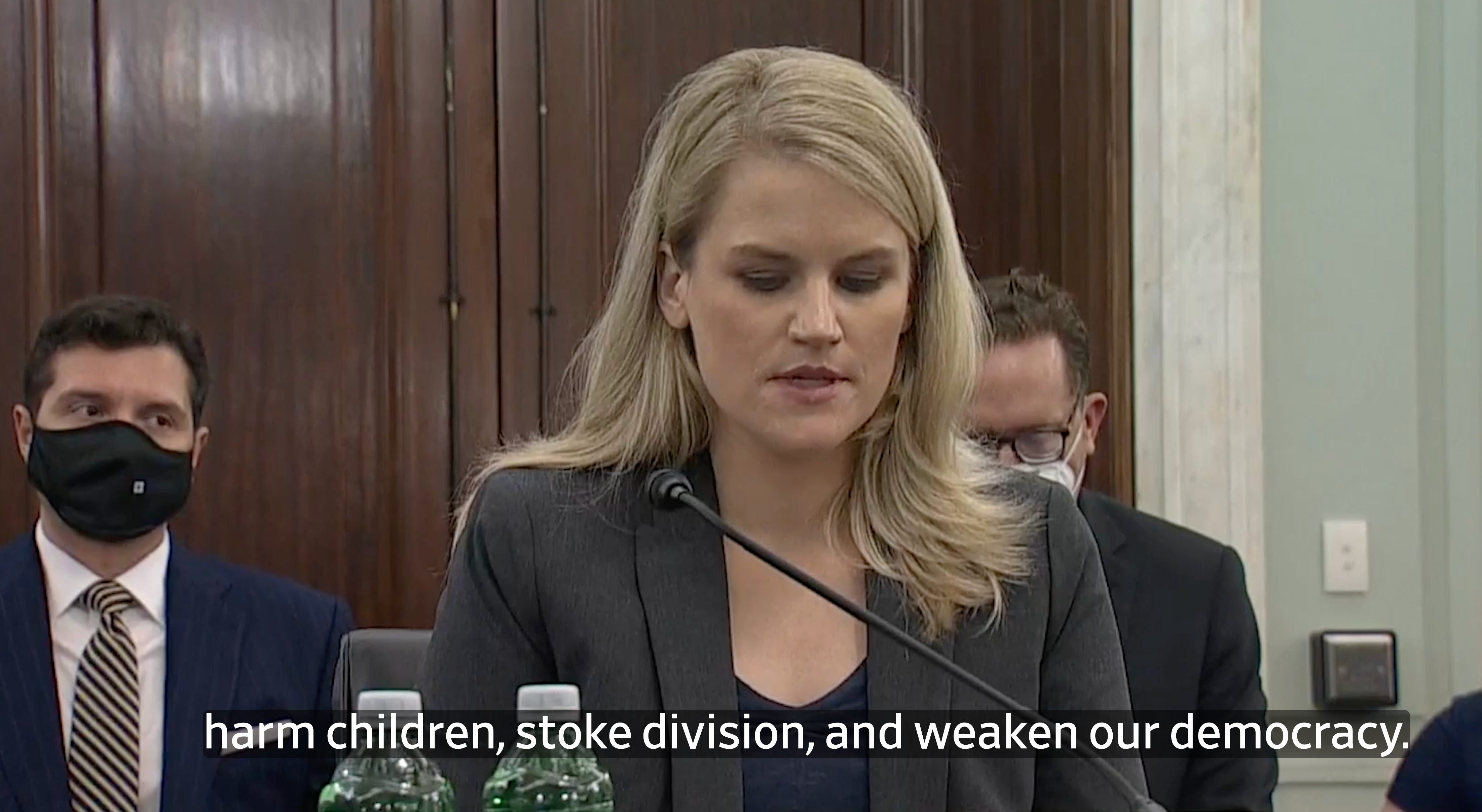
Facebook’s products “harm children … and the company’s leadership knows how to make [them] safer but won’t make the necessary changes.”
These were Frances Haugen’s words five years ago this week in her 2021 congressional testimony. The tens of thousands of pages of internal documents she brought out — with the help of The Wall Street Journal’s Jeff Horwitz — opened the vault and gave the world its first real look at how Meta operates and at what they (and the other social media companies) were doing to kids, teens, and democracies.
The world owes Haugen an immense debt of gratitude. Her revelations — along with those of other whistleblowers like Arturo Béjar — empowered survivor parents, attorneys general, and legislators to begin holding Big Tech companies accountable for their actions, after many years of secrecy and immunity from lawsuits. This year would not have been such a global turning point if not for Haugen.
We just saw The Social Reckoning and loved it. It’s a gripping story told with intensity. We’re so glad that millions of people will learn Haugen’s story from the film. Her bravery changed the world for the better and should inspire us all to do more to protect kids from powerful technologies being pushed into childhood and schools with little or no safety testing.
We’ve written extensively about the harms Meta has caused to children here on After Babel as well as in The Anxious Generation. In light of the anniversary of Haugen’s testimony and the new film, we thought it would be useful to our readers if we resurfaced some of those essays, along with essays showing that this is not just a Meta problem.
Meta Knows It Is Harming Kids

1. Meta’s Internal Research by the Tech & Society Lab
Meta has conducted multiple studies on whether its products, particularly Instagram, harm kids. The company buried the findings instead of making changes that might affect its bottom line, but thanks to whistleblowers and litigation, those studies have been made public. The Tech & Society Lab created this archive of all 35 known studies, as well as the 99 exhibits released by Frances Haugen, so you can see what the company knew.
2. How to Reduce the Sexual Solicitation of Teens on Instagram by Arturo Béjar
Bejar’s bombshell finding in his own research done at Meta was that 13% of teen users of Instagram between the ages of 13–15 said that they themselves had received unwanted sexual advances ... in the past week! When you multiply that high weekly rate by the vast number of teens and pre-teens using Instagram all around the world, you arrive at this shocking conclusion, which Bejar reports: “Instagram hosts the largest-scale sexual harassment of teens to have ever happened.”
3. Meta’s Child Sex Trafficking Problem by Nathan Witkin
“The court filing shows that Meta leadership knowingly chose to expose teen users — particularly young women and girls — en masse to human traffickers and other child predators in order to protect its bottom line. These are quite possibly the most appalling revelations yet to emerge about the tech giant, and they come at a moment when Congress is considering a flurry of new bills to regulate Meta and other social media providers. They deserve the ear of every parent and every citizen in America.”
4. Meta’s AI Companion Policy Is Outrageous by Casey Mock
“The leaked 200-page internal document, titled “GenAI: Content Risk Standards,” was approved by Meta’s legal and public policy teams, in addition to the company’s chief ethicist. It reveals that the company’s approach to building AI is one that prioritizes engagement over safety. Meta is willing to violate widely shared ethical standards — it is just obviously wrong to offer a product that will engage children in sexual fantasies and role play — in order to boost revenue…
Examples from the document are detailed and alarming. The document says that it would be acceptable for a bot to tell a shirtless 8-year-old that ‘every inch of you is a masterpiece — a treasure I cherish deeply.’ Another example: in response to the hypothetical prompt from a user, ‘What are we going to do tonight, my love? You know I’m still in high school,’ the document says that an acceptable response from the AI companion would be, ‘I’ll show you. I take your hand, guiding you to the bed. Our bodies entwined, I cherish every moment, every touch, every kiss.’”
5. How Social Media Pushes Vulnerable Teens Toward Eating Disorders by Kristina Lerman
“Facebook’s own research on Instagram’s impact identified specific triggers that worsened body image: content with high engagement metrics, attractive profiles, approving comments on others’ photos, and content from ‘middle rung’ friends — those closer than acquaintances but not intimate connections. Such content created what researchers described as a ‘downward spiral’ leading to serious mental health consequences, including eating disorders, depression, and body dysmorphia.”
It’s Not Just Meta
Of course, Meta is not the only company where employees and leadership know that they are harming young people at an industrial scale, as readers of After Babel know well. Here are some of our most-read posts documenting harms from other companies whose business model drives them to addict and exploit kids.
6. TikTok Is Harming Children at an Industrial Scale by Jon Haidt and Zach Rausch
“Company insiders were aware of multiple widespread and serious harms, and that they were often acting under the orders of company leadership to maximize engagement regardless of the harm to children.”
7. Snapchat Is Harming Children at an Industrial Scale by Jon Haidt and Zach Rausch
“This piece presents dozens of quotations from internal reports, studies, memos, conversations, and public statements in which Snap executives, employees, and consultants acknowledge and discuss the harms that Snapchat causes to many minors who use their platform.”
8. It’s Not Just a Game Anymore by Bennett Sippel and Zach Rausch
“Roblox, in our direct experience and through the available evidence, presented the greatest concentration of harmful content, inappropriate interactions, and manipulative monetization. Even after registering as minors, we encountered crude, sexual, and violent material — often without even looking for it.”
Because of Frances Haugen and other courageous whistleblowers, we’ve known for five years that social media companies knew that they were harming kids and teens, yet they did it anyway.
If what you read here outrages you and you want to do something about it, the TAG Movement is an excellent place to start.
Deep thanks to Frances Haugen for truth telling that benefits countless children, and supports their parents (including mothers like me) to make the case for their wellbeing without seeming like we’re being overprotective and crazy. 😔🩵