


While it is well documented that social media poses significant risks to youth mental health, the long-term cultural trends that inflated its influence have received much less attention. I argue that a decades-long shift to permissive parenting created a governance vacuum — an absence of necessary rules and expectations — that left Gen Z uniquely vulnerable, providing the ideal environment for a screen-based childhood to take hold and compound the prevailing mental health challenges of adolescents.
As Gallup’s Principal Economist, I regularly field and analyze surveys on well-being and mental health. As a parent of four, I became particularly alarmed by the troubling signs of adolescent discontent documented by Jonathan Haidt and many others. Having worked in clinical psychology as a young man — at residential care facilities and other settings, I have long known that family context matters greatly for youth mental health, providing either resilience or vulnerability depending on the strength of parent-child relationships.
With this in mind, in 2023 and 2025, my colleagues and I fielded representative surveys of U.S. parents and their adolescent children (ages 13–19) exploring mental health, parenting practices, and how adolescents are spending their time with screens and other activities.
I wanted to know how best-practice parenting relates to adolescent mental health. Psychologists hold many perspectives on parenting, but a widely accepted view is that the most effective parents both respond to the needs of the child (e.g., provide warmth, affection, sympathy, and security) and demand appropriate behavior.
This model can be illustrated as a two-dimension classification scheme, based on a diagram adapted from psychologists Eleanor Maccoby and John Martin in their influential overview of the literature.1
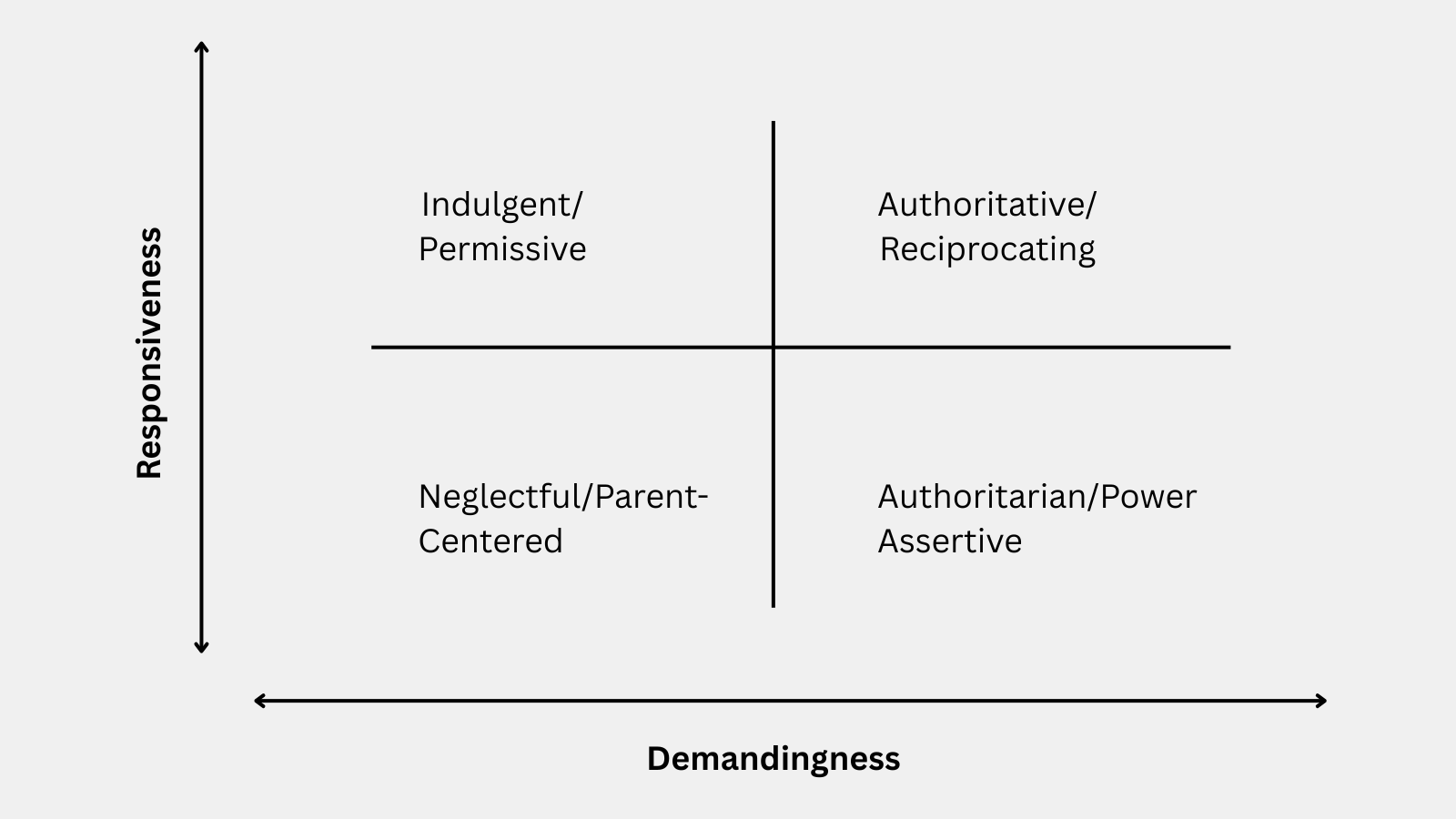
At the bottom left of the model are parents who are neither responsive nor demanding. According to the theory, they ask little of their children and provide little in attention or affection, a pattern thought to be harmful to development. The upper-left and bottom-right patterns are also associated with relatively poor outcomes because they are strong in only one dimension. Parents who are demanding but not responsive tend to score lower on measures of parent-child relationship quality and risk undermining the legitimacy of parental authority. Meanwhile, parents who are responsive but not demanding may fail to foster the self-efficacy and moral character of their child.
Parents who combine both elements were described as authoritative by parenting theorist Diana Baumrind. This combination is important to youth mental health because a large body of research finds that authoritative parenting has meaningfully large and beneficial associations with youth mental health. My own work reaches similar conclusions: parents who are both responsive and demanding tend to have children with the best mental health and highest quality relationships with their parents.
If authoritative parenting is most strongly associated with positive youth outcomes, an important question is whether parenting practices have shifted toward or away from this model over time.
What We Know About How Parenting Has Changed
Measuring parenting is difficult, and tracking changes in parenting over time is even more challenging. Parents do many things for and with their children and adapt their priorities based on what they believe their child needs. With these limitations in mind, there are a few things we know.
As the 20th century unfolded, parents increasingly came to value autonomy over obedience in their children. This shift appears across several decades of surveys asking parents to rate the importance of various qualities that they think children should learn. Data from the General Social Survey show that the percentage of U.S. parents selecting “to obey” as one of the two most important things for children to learn fell from 40% in 1986 to 18% in 2024.
Similar trends have been observed globally, according to data collected on the World Values Survey. Among countries with data going back to 2000 or earlier, most saw a decrease in the share of parental valuation of obedience, with large decreases in countries such as the United Kingdom, Chile, Taiwan, Canada, and Spain. Parents continued to value authority at high rates in countries such as Brazil, Mexico, Turkey, and Estonia. In general, parents tend to give less importance to obedience if living in a high-income country.
Other evidence is consistent with this pattern. Parental strictness declined and tolerance of children expressing anger toward parents increased between the mid-20th and early 21st centuries. Parents also seem less inclined to have their children undertake paid work. For example, summer employment rates among U.S. teenagers fell from 57% in 1976 to 38% in 2024, according to data from the Current Population Survey. In short, parents appear to have become less demanding and more permissive (as has also been argued by Dr. Leonard Sax in his book, The Collapse of Parenting).
Although the term “obedience” can carry negative connotations in modern discourse, most people would likely agree that obedience to laws and to basic social norms of decency and mutual respect remain important. Parents generally want children to listen to instructions and follow rules.2
New Evidence on Parenting Changes by Generation
To further understand how parenting practices may have changed over time, my colleagues and I at Gallup fielded a survey of parenting in July 2024. We asked a representative sample of U.S. adults to answer questions about how they were parented as children, using 12 years of age as a reference point. By comparing the answers given by various birth cohorts, we can observe (imperfectly, to be sure) whether retrospective perceptions of parents have changed over time. Respondents reported separately about their mother (or maternal figure) and father (or paternal figure), depending on whom they lived with at the time.
We found little to no difference in parents’ warmth, affection, or responsiveness. For example, 44% of adults born between 1930 and 1949 agreed with the statement their father “was very warm and affectionate toward you.” For those born between 1995 and 2006, 41% agreed.
There were, however, much larger differences in the demanding aspects of parenting. The two items showing the largest changes were:
“You knew he would punish you or take away a privilege if you did something that was wrong” and
“He set reasonable rules for your behavior and always enforced them fairly”
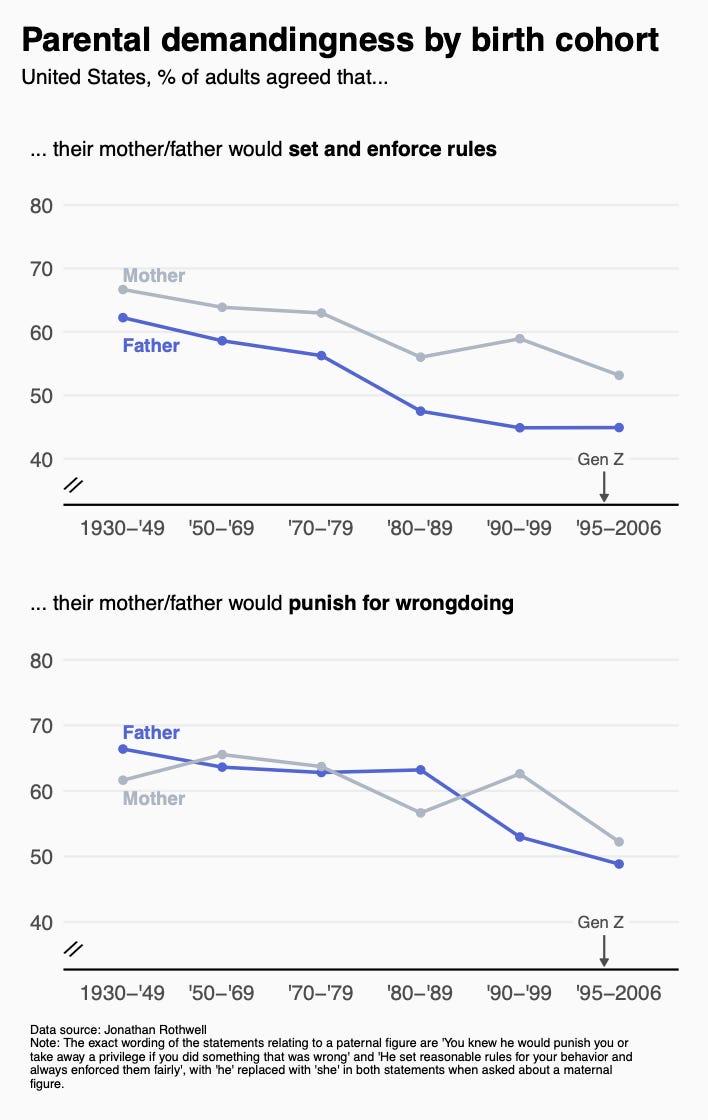
Similar items asking about the mother also showed large changes. In both cases, respondents from more recent birth cohorts were significantly less likely than those from older birth cohorts to agree, consistent with the decline in demandingness described in the literature.
Regulating Smartphones at Home
The measured fall in demanding parenting comes at a time when adolescents are confronted with new technological temptations that require parental guidance. Thus, the partial relinquishing of parental governance increases vulnerability to the harms of social media, video games, and other habit-forming products.
As has been widely discussed on this Substack, adolescents spend alarming amounts of time using social media. In a 2023 Gallup survey, we found that the average U.S. teenager reports spending nearly five hours per day on social media. Research on young adults suggests that a meaningful portion of this use exceeds what users themselves say they would prefer. Many parents likewise report wishing their children spent more time on schoolwork, hobbies, or offline activities.
Yet, as part of the same survey, less than half of parents of children ages three and older agreed with the statement, “I restrict screen time (such as TV, tablet or phone) to certain times of the day.” Limitations were even less common among parents of adolescent children, with only 30% agreeing they restrict screen time.
The partial relinquishing of parental governance increases vulnerability to the harms of social media, video games, and other habit-forming products.
Consistent with the broader argument, parents who do restrict screen time tend to have children who report less time using social media. On average, teens whose parents set limits report about 1.4 fewer hours per day on social media. They also report less time spent on video games, less time alone, and more time devoted to homework, chores, hobbies, and practicing sports or arts — patterns that are generally associated with better mental health outcomes.
Not surprisingly, parents who score high on demandingness are more likely to restrict screen time. For example, 36% of parents of adolescents who strongly disagreed with the statement “I have a hard time saying no to my child” reported restricting screen time, compared with 13% of those who strongly agreed. Parents who identify with a religious tradition are also more likely to restrict screens than parents who identify as atheist or agnostic.
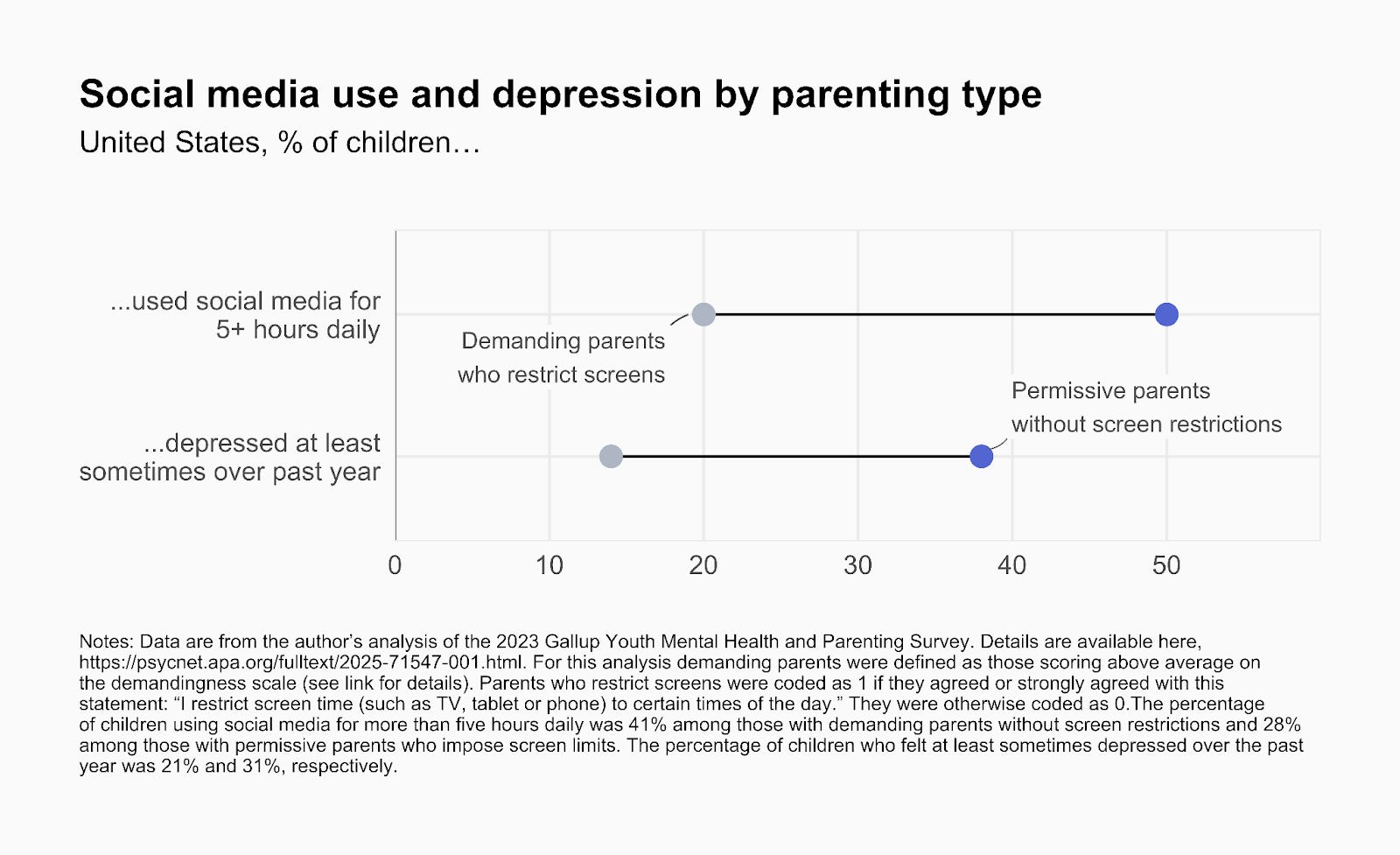
Overall, these data show a strong association between adolescent mental health and being raised by a demanding parent who also restricts screens. Among parents who were high in demandingness and restricted screens, 14% reported that their child had been at least sometimes depressed in the past year, and only 20% reported that their teen spent five or more hours per day on social media. By contrast, among parents who were permissive and did not restrict screens, 38% reported that their child had been at least sometimes depressed, and 50% reported five or more hours of daily social-media use. Results were similar when using a broader index combining multiple emotional and well-being measures.
My Advice: Respect Your Authority
My interpretation of these data and decades of related research leads me to believe that children need guidance and structure in order to thrive. They benefit from clear rules and boundaries that are appropriately enforced. The evidence suggests that the mental health challenges facing today’s youth are unlikely to stem from a decline in parental warmth or affection. By most accounts, contemporary parents are at least as responsive as those of earlier generations. The more notable shift appears to be a reduction in the demands that parents place on their children.
I believe this perspective is relevant to parents, grandparents, step-parents, or anyone else who has responsibility for the welfare of a child. It’s perfectly appropriate to set boundaries and enforce rules generally and with respect to screens. A “no social media” policy strikes me as the best default. Whether your child can otherwise handle a smartphone responsibly will likely depend on the child, but it seems to me that there are plenty of less distracting options available, such as smartwatches. Calling and texting friends and family is unlikely to be harmful. Risks from social media often stem from viewing content posted by and interacting with strangers.
None of this is to say that restricting screens is easy. Digital platforms are deliberately designed to capture attention, and some children will be more resistant than others to parental limits. Parents may need to adjust their approach over time, including monitoring usage or setting graduated rules. Strong and consistent boundaries are helpful, but each family must determine what works within its own circumstances.
These data and decades of related research leads me to believe that children need guidance and structure in order to thrive. They benefit from clear rules and boundaries that are appropriately enforced.
The challenge is compounded by the pace of technological change, which often leaves adults themselves uncertain about what constitutes responsible use of social media and AI. Many digital tools offer genuine benefits. In my own family, educational apps have reinforced early reading and math skills, online instructional videos have supported exercise and skill-building, and games have helped pass time during travel or bad weather. AI tools have also helped me identify age-appropriate books and family-friendly films.
Parents therefore face a balancing act: how to preserve these benefits while minimizing exposure to documented risks. Companies could help parents by increasing their efforts to restrict access to potentially harmful content. Ultimately, even without the cooperation of tech companies, decisions about whether and how a child uses digital technology belong to parents. Pleasing children in the short term is not as important as ensuring their long-term well-being.
Maccoby, E. E., & Martin, J. A. (1983). Socialization in the context of the family: Parent-child interaction. In P. H. Mussen (Series Ed.) & E. M. Hetherington (Vol. Ed.), Handbook of child psychology: Vol. 4. Socialization, personality, and social development (4th ed., pp. 1–101). Wiley.
There are several theories proposed around why obedience is perceived as less important. One theory is economic. The rise of a post-industrial economy, with its demand for creative professional workers, may have encouraged parents to prioritize autonomy and self-expression over conformity. Another account, proposed by evolutionary biologists and cultural scholars, is that modernization increased the value of individualistic traits as people moved from tight-knit communities into large urban societies, weakening traditional family and kin authority.

I also appreciate the analysis by Jonathan and definitely agree that children need boundaries and structure with a foundation of love and attention. One fact that I think is being left out of Jonathan‘s analysis, and one, given that he is an economist, he should consider: the economics of family life. Over the past 50 years Our economy has shifted from a single wage earner being able to support a family and even buy a home, leaving one parent with more energy to invest in the children, to now either both parents are working or it’s a single parent family with that parent working. Parents are TIRED!. Providing structure and authoritative Parenting takes a lot of energy. Being tired is no excuse for not providing boundaries and controls over social media. However, it sure is easier to let your child play on an electronic device when you’re tired. The child seems happy. Maybe you feel a little guilty because you know it’s not the best thing for them but you gotta get to bed and get up the next morning and go to work. The secular trend of increased time working by parent figures in the family is completely lacking in the current analysis and I think it’s a major factor in the rise of social media use by children.
My daughter is almost 13 and often tells me, after observing other parents’ permissiveness, “Mama, s/he needs to be more strict.” 🫀 Love guides my parenting; I declared it as my religion when I was 8 and I’m now 50. It informs strong boundaries with screens; she has no cell phone and very limited social media (I’d prefer none yet her father’s house has different rules). 😔 Love INCLUDES firm protection of the child. My daughter feels safe with how she is parented, and I hear a strong invitation in this essay for more of us to show our children that Love, in its vast capacity to adore & uplift & liberate them, also fiercely protects them. 🐻