



As policies meant to protect adolescents from the potential risks of social media gain traction around the world, the central question is shifting from whether social media causes harm, to whether government regulation is the right solution. As a consequence, policy measures that would restrict access to social media among young people are subject to widespread public debate. With vocal groups on both sides, and tech giants spending a lot of money to influence the debate, policymakers and legislators can benefit from a clear understanding of how these opposing views are distributed in the public population. In other words, how do average people feel about laws that regulate and restrict children’s access to social media platforms?
To address this question empirically, we conducted opinion surveys to a representative sample of both the adult population and adolescents (ages 14–17) in Germany. We asked about views on policies that restrict youth social media access as well as broader perspectives on social media use and related risks. While the data is geographically restricted to Germany, our findings provide relevant evidence that can help inform the international debate as well as policymaking in other nations.1
Background
We implemented the study as part of the ifo Education Survey, an annual opinion survey on various topics of education policy that we have been running since 2014.2 This year, our focus was on social media (as well as questions on artificial intelligence and digitalization more broadly, not covered here). The survey was in the field during May and June 2025, surveying almost 3,000 adults (ages 18–69) and over 1,000 adolescents (ages 14–17).3 In the surveys, we define social media as “websites and apps that allow users to create profiles, communicate with each other, post their own content, and view and comment on others’ content (e.g., Instagram, Facebook, or TikTok).”
Currently, there is no legally defined age minimum for social media use in Germany, nor is there any regulation requiring platforms to verify users’ ages. Most platforms stipulate an unenforced minimum age of 13 in their terms of use, and young people ages 13–16-years-old need their parents’ consent. However, usage data among children below the age of 13 show that these rules are effectively ignored in practice.
For context, we found that 90% of adults in Germany and 96% of adolescents report using social media every day (see Figure 1). Seventy-eight percent of adolescents use social media for an hour or more on weekdays, and 55% of adolescents spend more than three hours per weekend day on social media.
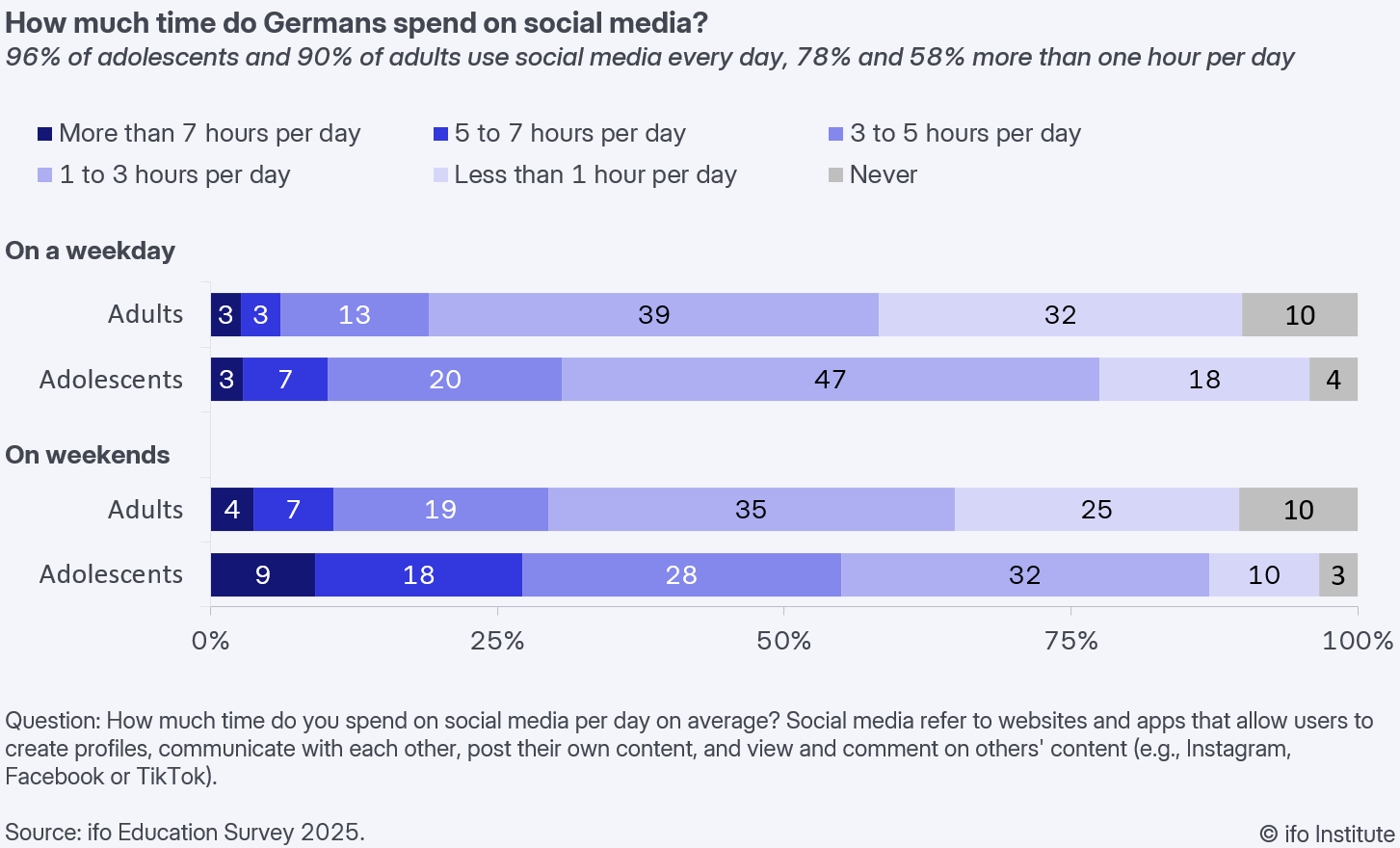
Figure 1. How much time do Germans spend on social media? Responses by representative samples of adults and adolescents (aged 14-17) in the ifo Education Survey 2025 in Germany, see Wedel et al. (2025).
The Public Strongly Supports a Minimum Age for Social Media
Given the ubiquity of social media use in Germany, we were interested in what the population thinks of a law that would prohibit children and adolescents under the age of 16 from creating social media accounts, such as the law passed in Australia in 2024.
As Figure 2 shows, a large majority (85%) of German adults are in favor of a social media minimum age of 16. More than half (57%) of adults are even “strongly” in favor. Surprisingly, a plurality of 47% of adolescents also endorse such an age restriction, while 42% are against it. Interestingly, there is a clear age difference on this question within the group of adolescents: 55% of 16- and 17-year-olds—who would no longer be affected by the measure but who have close memories of their recent years—endorse a minimum age of 16 for social media. Among 14- and 15-year-olds—who would be affected by the minimum age themselves—51% are against it; but still, 39% support it. This means that even in the affected group of under-16-year-olds, a considerable proportion is in favor of restricting social media usage in their own age group.
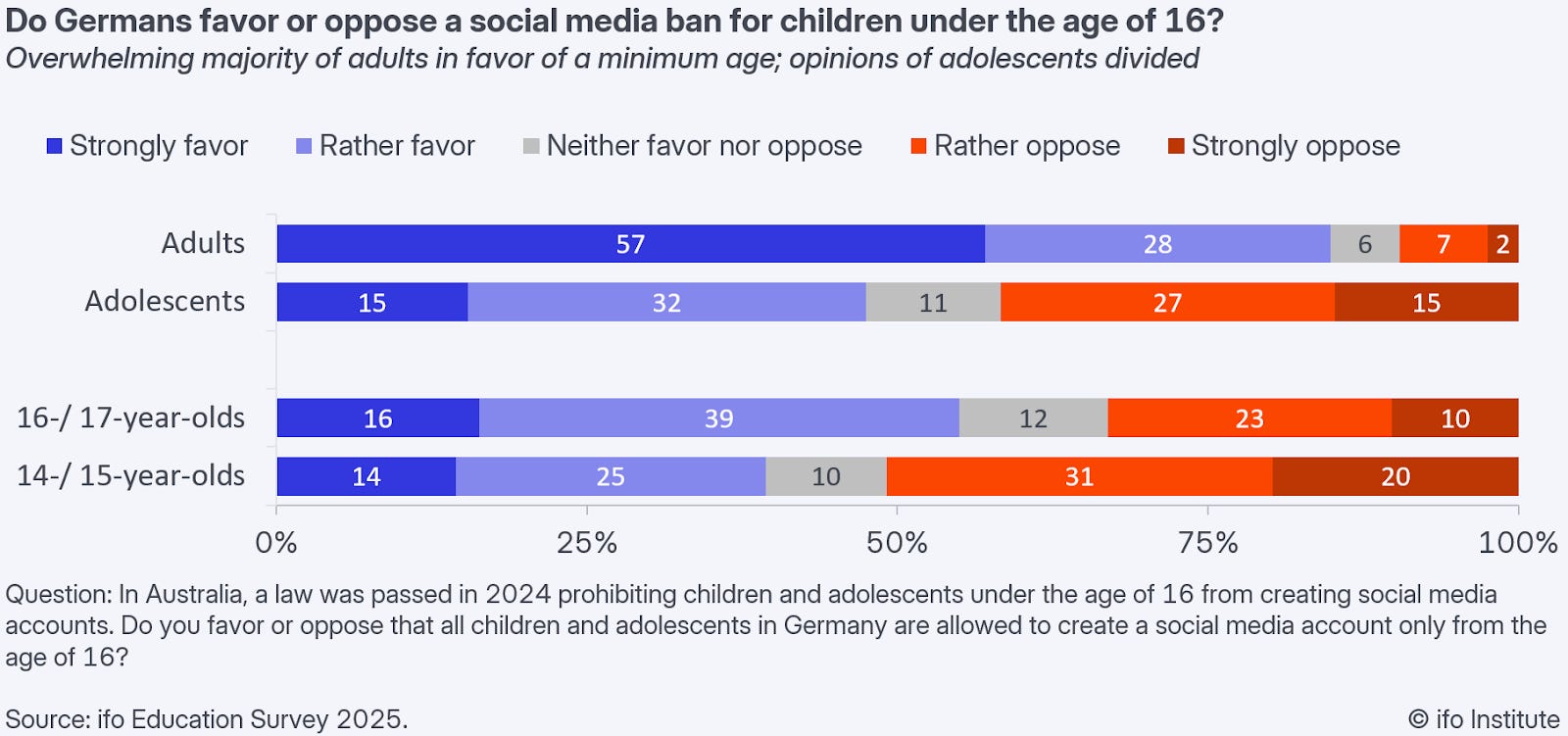
Figure 2. Do Germans favor or oppose a social media ban for children under the age of 16? Opinions expressed by representative samples of adults and adolescents (ages 14–17) in the ifo Education Survey 2025 in Germany, see Wedel et al. (2025).
Widespread Concerns About Social Media Usage Among Children and Adolescents
Why does so much of the population support social media restrictions for adolescents despite near-universal daily use of these platforms? Both adults and adolescents perceive significant negative effects of social media use on minors, especially concerning their mental and physical health. As Figure 3 shows, 77% of adults and 61% of adolescents believe that social media has a negative impact on mental health, and 73% and 66%, respectively, believe it has a negative impact on physical health.
Respondents also expect negative effects on attention and school performance: 72% of adults and 59% of adolescents perceive negative effects on youths’ attention, and 69% and 54%, respectively, see negative effects on school performance.
A majority of adults also see negative influences of social media on social skills, identity formation, and the formation of political opinion, while adolescents’ opinions on these three dimensions are more divided.
The only measure where respondents predominantly believe that social media has a positive impact on the young generation was “gathering information” (53% of adults and 71% of adolescents).
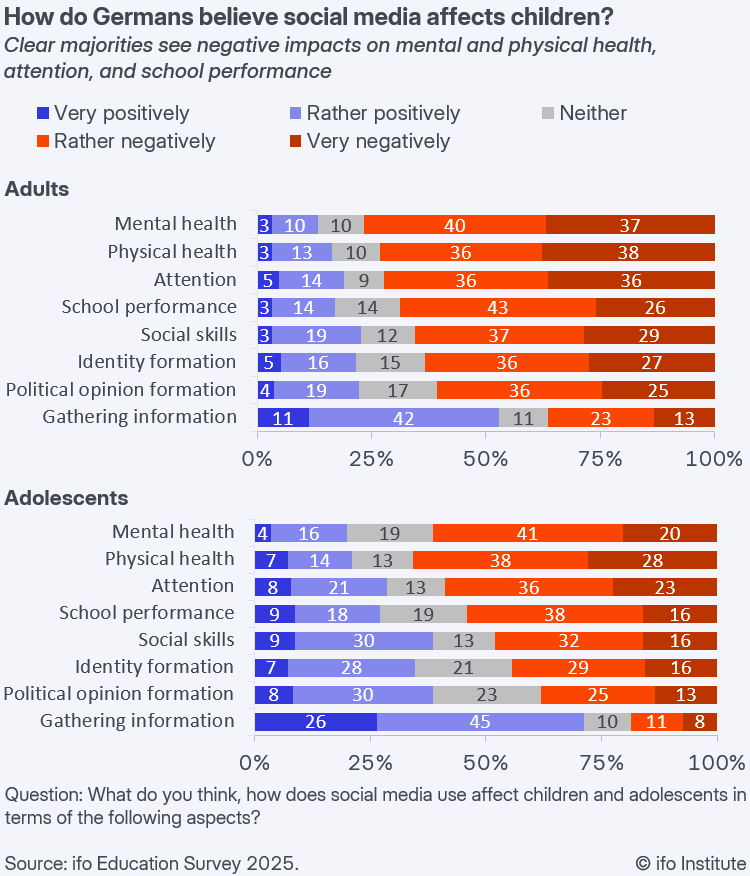
Figure 3. How do Germans believe social media affects children? Opinions expressed by representative samples of adults and adolescents (ages 14–17) in the ifo Education Survey 2025 in Germany, see Wedel et al. (2025).
Overall, the negative perception of social media is more pronounced when considering the impacts on young individuals. An overwhelming majority of adults (87%) believe that social media brings more disadvantages rather than advantages for children ages 0–13, and 65% even perceive clear disadvantages (see Figure 4). Similarly, 77% of adolescents believe that social media has disadvantages for children in this age range.
The generations are divided when it comes to assessing social media for adolescents ages 14–17: While 63% of adults see mainly disadvantages and only 19% see advantages, nearly half (49%) of adolescents themselves perceive advantages. However, 29% of adolescents also believe that social media has disadvantages for their own age group. Around half of adults (50–56%) and adolescents (49–58%) believe that social media offers mainly advantages for adults ages 18+.
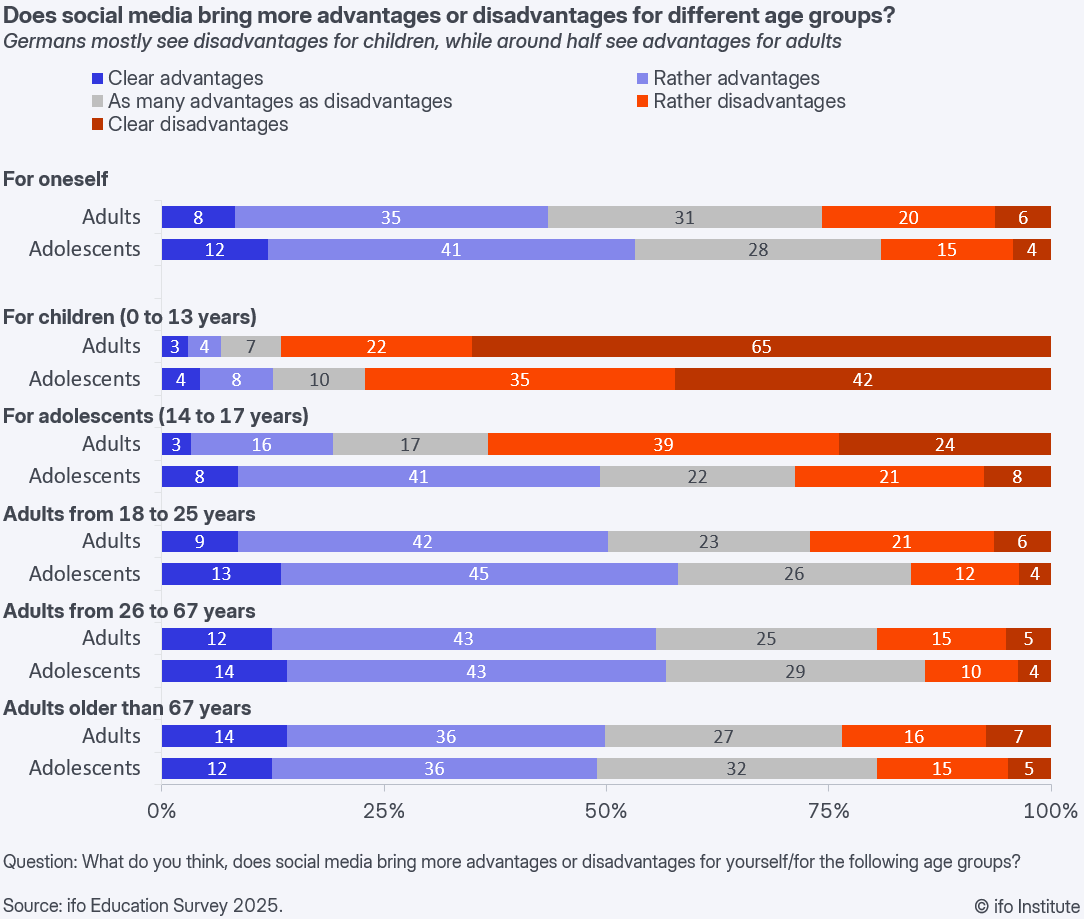
Figure 4. Does social media bring more advantages or disadvantages for different age groups? Opinions expressed by representative samples of adults and adolescents (ages 14–17) in the ifo Education Survey 2025 in Germany.
Broader Assessment of Social Media
Finally, we asked for people’s opinions on social media beyond the impact on children. Generally, opinions are mixed as to whether social media is viewed as an opportunity or as a risk for society in general, and for education in particular. Figure 5 shows that 37% of adults consider social media an opportunity for society, while 45% see it as a risk. Adolescents’ assessment is somewhat more positive: nearly half of them (47%) see social media as an opportunity, while 33% see it as a risk.
The opinions concerning the influence of social media on education are slightly more negative in both groups.
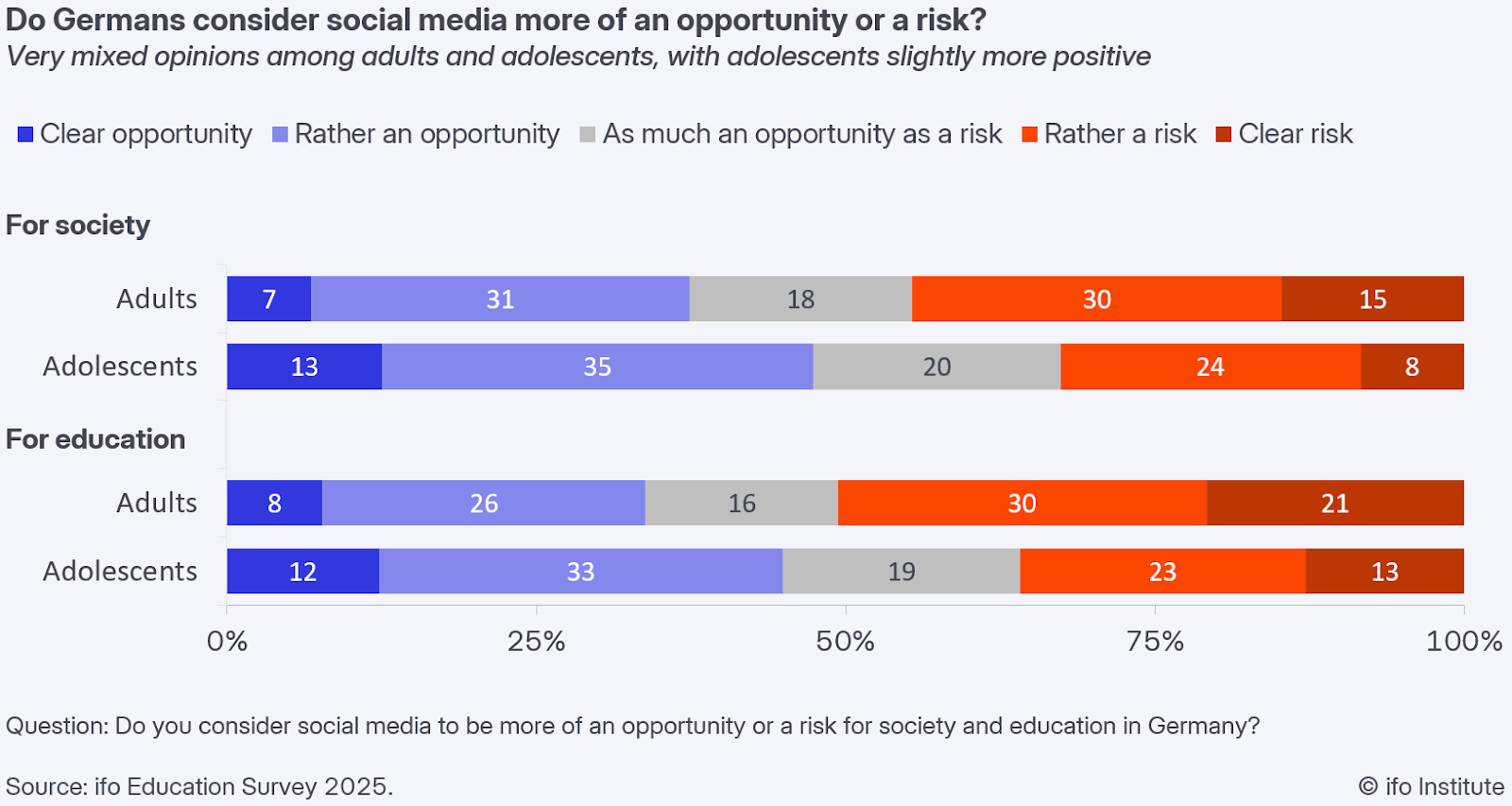
Figure 5. Do Germans consider social media more of an opportunity or a risk? Opinions expressed by representative samples of adults and adolescents (ages 14–17) in the ifo Education Survey in Germany 2025, see Wedel et al. (2025).
In addition, we asked participants whether they would rather live in a world with or without social media. Prior work by Bursztyn et al. (2025) has shown that this kind of hypothetical question strongly correlates with an incentivized measure of preferences for social media access. As shown in Figure 6, a plurality of 47% of adults would rather live in a world without social media, while 40% would prefer to live in a world with social media. This assessment is quite telling, given the ubiquitous usage of social media among adults. In contrast, more than two-thirds (68%) of adolescents say they would rather live in a world with social media, while only 19% would prefer to live in a world without social media.
To make sure that these assessments relate to social media in particular rather than to online features more generally, we also asked participants whether they would prefer to live in a world with or without Google Maps. Unlike social networks, Google Maps neither creates social exclusion mechanisms nor does it influence social status in comparison to others. Clear majorities of 85% of adults and 77 % of adolescents respond that they would rather live in a world with Google Maps. This shows that the more negative attitudes of adults towards social media reflect a rejection of social media in particular, as opposed to digital tools in general
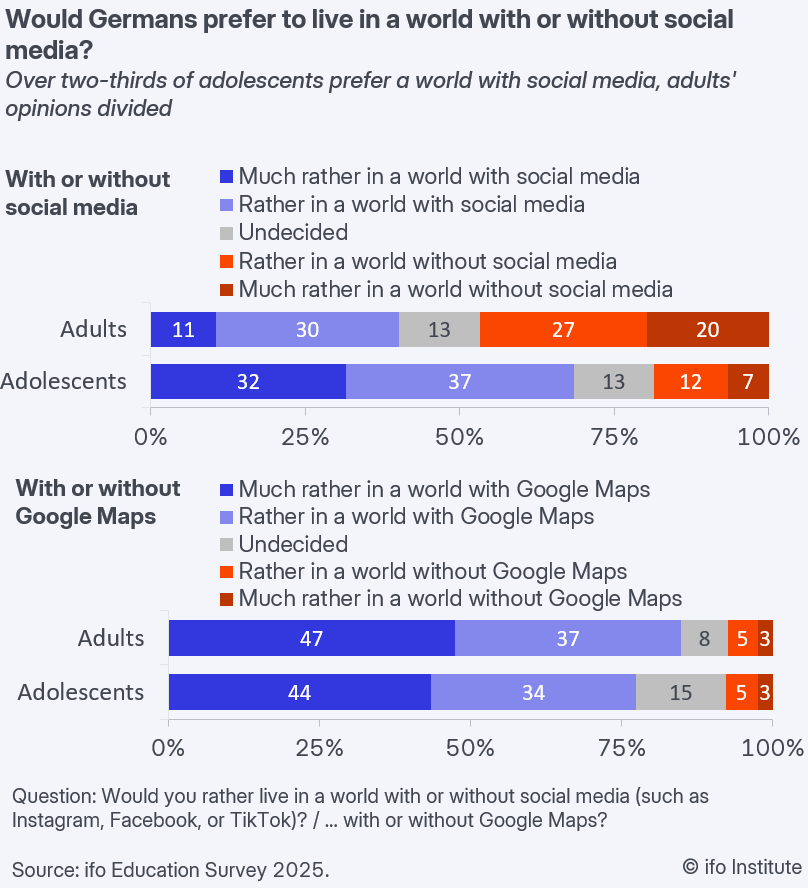
Figure 6. Would Germans prefer to live in a world with or without social media? Opinions expressed by representative samples of adults and adolescents (ages 14–17) in the ifo Education Survey in Germany 2025, see Wedel et al. (2025).
Previous studies have sometimes shown higher levels of regret, but methodological differences make direct comparison difficult. These previous studies refer to different samples and tend to focus on specific social media platforms rather than social media overall. For example, 58% of a sample of U.S. college students in a study by Bursztyn et al. (2025) say they would prefer to live in a world without Instagram, and 57% without TikTok. Strikingly, among TikTok users the share is much lower (33%). In another U.S. study of a representative sample of young adults (ages 18–27), 47% say they wish that TikTok was never invented, and 34% say they wish Instagram was never invented. In that U.S. study, regret was much lower for smartphones (21%), the internet overall (17%), and YouTube (15%). By contrast, in a U.K. study of young people ages 16–21, nearly half (47%) said that they would prefer to live in a world without the internet.
Germans Want To Protect Children Online
The European Parliament recently called for a Europe-wide minimum age of 16-years-old for social media use among minors, as well as “stricter enforcement of EU digital rules, with fines and potential bans for non-compliant platforms,” among other safety measures. Based on the sentiments revealed in our survey, such policy measures would fall on fertile ground in Germany — and perhaps elsewhere too. As the widespread debate shows, many industrialized nations share the German public’s concerns around the effects of social media use on youth mental health and academic achievement. The overwhelming public support observed in Germany suggests that an age minimum for social media use, such as the one recently implemented in Australia and recommended by the European Parliament, could find broad acceptance in many other nations.
Other surveys have found similarly high rates of concern, across Western nations.
Our prior research has focused on topics such as public support for university tuition, children’s faring during Covid-19, educational inequality, and educational spending (published in the Journal of Public Economics and the European Economic Review), among others.
The survey is conducted annually among adults. We had implemented a survey of adolescents once before, in 2018, which we used in research on educational aspiration gaps published in Economica and on public preferences for income-contingent university tuition forthcoming in the Journal of Political Economy Microeconomics, among others.


The danger here is that these new laws can be the backdoor to rolling out biometric ID, harvesting sensitive data from children and adults, as is already being done in Australia and Substack's chat platform.
Strong public support, by itself, justifies nothing. There was strong public support for Hitler, right up until Germans started feeling the pain of having launched WWII. Strong public sup[port does not justify persecuting a minority.
Before going still deeper in providing further means for the state to subjugate its citizens, you might want to consider the way things already are. Check out how CJ Hopkins was treated by Germany for a simple book cover.
If you don't want your kids on social media, then keep them from it. You figure can't always do that? No you can't. And neither can the government. You have your kids from birth. You are full of opportunities to teach them values, including self-reliance and self-respect. Don't hand off those responsibilities to Big Brother. It will not/has not gone well.
It is every easier for Big Brother to track everything that everybody does, and to coerce them into abiding by the dictates of Big Brother.
It is essential, above all else, that any citizen can openly criticize his government without fear of reprisal. It is nothing like that in Germany, and it's getting worse.