

Introduction from Jon Haidt and Zach Rausch:
Longtime After Babel readers will recognize today’s guest author, Seth Kaplan, lecturer at Johns Hopkins and author of Fragile Neighborhoods. In previous essays, he has argued that loss of community is an upstream cause of the youth mental health crisis, and that restoring the play-based childhood requires rebuilding strong local communities. Today, he highlights a once-vital institution of childhood — community-based groups like Scouts, Little League, 4-H, and youth ministries — and makes the case that local, youth-led community groups are among the most powerful tools we have for restoring the rich, place-based social lives that children need to flourish.
– Jon & Zach
We Took Away the Phones — Now What?
The movement Jonathan Haidt and his colleagues helped catalyze has already achieved something remarkable, shifting norms around children’s technology use that once felt immovable. But the school phone bans, social media age restrictions, and platform regulations are only part of what we need in order to restore the play-based childhood. We need to pair those gains with an equally ambitious effort to renew the social ecosystem that once made kids’ off-screen lives robust and intensely local.
Phones did not simply replace something good, as I previously argued on After Babel; they filled a void created by the earlier loss of community and the decline of the play-based childhood. If that diagnosis is correct, then reducing screen time — while essential — addresses only part of the problem. If we remove phones without rebuilding the social architecture that once gave childhood meaning, agency, and joy, we risk leaving kids with less stimulation but not more formation.
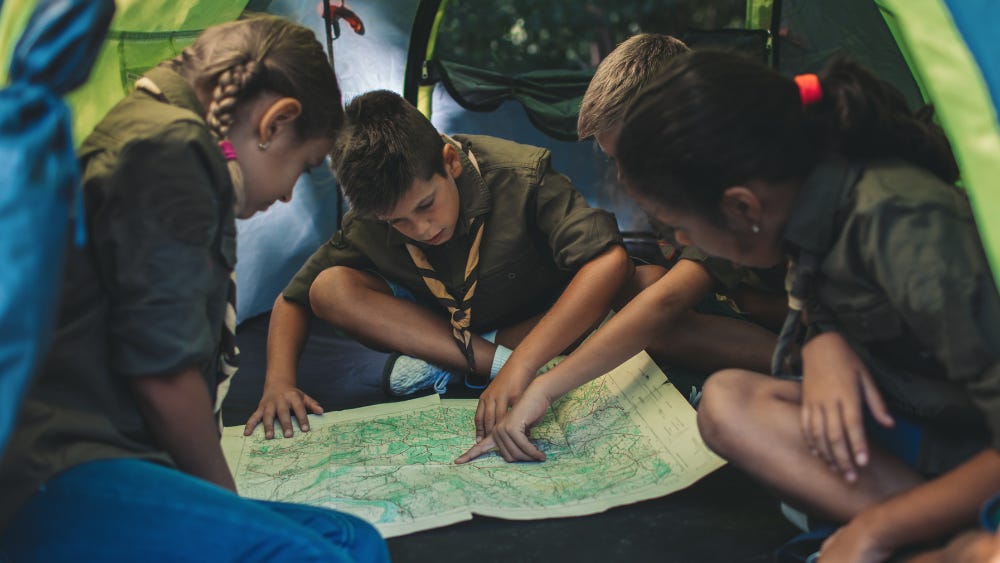
One element of that ecosystem stands out for its proven ability to cultivate independence, belonging, leadership, and joy: place-based, in-person youth community groups. I don’t mean highly structured enrichment activities, competitive travel teams, or online communities. In the past, groups such as Scouts, neighborhood and settlement-house clubs, after-school and park-based leagues, Boys & Girls Clubs, church youth fellowships, 4-H chapters, and informal block-based play groups provided millions of American children with daily opportunities to be together without screens, without hovering parents, and without performance pressure.
If we are serious about restoring the play-based childhood, we must do more than limit what children consume — we must rebuild the social architecture that makes off-screen life rich and compelling. That begins with placing far greater value on youth community groups and treating them not as optional enrichment, but as essential infrastructure for growing up.
What We Lost
In the heyday of youth community groups, kids’ social lives were embodied, local, and immediate. Children spent hours each week with peers, building forts, organizing games, planning events, or simply hanging around. They were building independence, responsibility, and connection, and had little incentive to retreat into solitary entertainment. These groups anchored childhood in real places, making neighborhoods feel alive and meaningful. Streets, parks, basements, and community halls became stages for shared memory rather than empty transit zones between scheduled activities.
Many of the most successful groups, including Scouts and 4-H, combined deep local roots with affiliations to larger regional or national networks. Local chapters were run by volunteers and embedded in neighborhoods, but drew strength, legitimacy, and meaning from being part of something larger than any single town or block. When either side of this equation weakens, the model becomes fragile.
If we are serious about restoring the play-based childhood, we must do more than limit what children consume — we must rebuild the social architecture that makes off-screen life rich and compelling.
Unfortunately, that’s exactly what occurred. Many of the largest youth organizations that once anchored childhood have seen substantial declines in participation over the past several decades. The Boy Scouts of America, for example, counted more than four million youth members in the early 1970s but has fallen to roughly one million today. Girl Scouts membership peaked at over 3.7 million in the early 2000s and has since declined to around 1.7 million. Similar patterns are visible across civic and community life more broadly: participation in voluntary associations, including youth-serving organizations, began declining in the latter half of the twentieth century, as documented by Robert Putnam and others. These trends predate smartphones by decades, suggesting that the erosion of youth group life was already well underway before digital technology accelerated it.
At the same time, a substantial body of research underscores the developmental value of sustained participation in these kinds of groups. Longitudinal studies of Scouting, for example, have found that kids who participate for multiple years show measurable gains in character attributes such as trustworthiness, helpfulness, and future orientation compared to non-participants. After two-and-a-half years of participation, Scouts themselves report “significant increases in cheerfulness, helpfulness, kindness, obedience, trustworthiness and hopeful future expectations.” Teenagers more broadly describe group involvement as enhancing self-development, emotion regulation, and interpersonal skills.
Adolescents involved in community-based activities demonstrate higher levels of civic engagement, lower rates of risky behavior, and stronger social and emotional skills, according to research on structured extracurricular participation. Even participation in local sports leagues — when embedded in community settings rather than elite travel systems — has been linked to improved teamwork, persistence, and mental well-being. Across contexts, the pattern is consistent: regular involvement in peer-based, adult-supported group activities contributes to healthier developmental trajectories.
Why is participation in these peer- and community-focused groups so positive for kids’ development? To start, they give children meaningful roles (not just symbolic ones): organizing younger kids, managing equipment, resolving conflicts, planning activities, running meetings, and so on. Responsibility and competence are learned by doing, and kids quickly learn that they matter to the functioning of the group.
Research also consistently shows that play across ages is one of the most powerful drivers of social learning and emotional regulation. When kids interact and play in mixed age groups, older kids learn patience and leadership, while younger kids learn courage and imitation.
These groups give children meaningful roles. Responsibility and competence are learned by doing, and kids quickly learn that they matter to the functioning of the group.
Hyper-local community-based groups also create thick relational ecosystems where conflicts must be worked through, not escaped, in contrast to digital “communities.” Local and persistent groups provide relationships that overlap with school, family, religious life, and neighborhood routines. Reputation matters. Trust accumulates.
But in their absence, two forces filled the gap: screens, which offer constant, low-friction entertainment, and highly structured activities, which organize children’s time but rarely replicate the social density of peer-led group life. Both have their place, but neither replaces what was lost. As we begin to roll back the phone-based childhood, we have an opportunity not just to remove a substitute, but to restore the institutions that once made childhood socially rich in the first place.
Where Youth Groups Still Flourish, and Why
My interest in youth groups stems from my own kids’ experience. One of their favorite activities from the time they were small has been the weekly synagogue groups. These start very young and are always led by older kids.
In some societies, these groups remain central to childhood. During a stay in Israel, my family experienced firsthand how central youth groups — tnuot noar — are to kids’ lives, consuming hours of time weekly and running throughout almost the entire year. These groups were easily the best ways for my kids to meet their peers in the neighborhood, create meaningful relationships, find a sense of belonging, and maintain (for my oldest) a steady social life they could manage completely on their own.
In Israel, roughly 30% of students participate in youth organizations or movements — far above levels seen in many Western contexts — and these groups are explicitly recognized by the Ministry of Education for strengthening identity, belonging, and civic integration. Organizations such as the HaTzofim (Hebrew Scouts) are among the most durable and widespread institutions in Israeli civil society, enrolling hundreds of thousands of children across ideological, religious, and socioeconomic lines. Activities emphasize play, hiking, service, and group projects over instruction or performance. Participation often begins in early elementary school and continues through adolescence, with teenagers doing most of the work locally.
What distinguishes these groups is not just scale, but structure. They are deeply place-based, organized around neighborhoods and towns rather than regions. Meetings are frequent, often multiple times per week. Older teens lead younger cohorts, with adults playing supporting rather than directive roles.
Crucially, these groups are socially normative. Participation is not an exotic enrichment option; it is simply “what kids do.” Parents expect it. Schools accommodate it. Neighborhoods are designed around it. Municipalities offer public spaces for meetings. Schools and camps make space in their schedules for complementary activities.
The payoff is visible. Research on Jewish youth programming suggests that long-term participation in youth movements has more durable effects on identity and social outcomes than short-term educational experiences. In this context, youth groups function not only as sites of frequent peer interaction and independence, but also as training grounds for cooperation, leadership, and resilience long before formal adulthood begins.
How Can We Revive Youth Community Groups in the United States?
American communities already have the people and resources to renew an ecosystem that anchors children and youth. Several large, nationally affiliated organizations still reach millions of American children each year. They possess something difficult to recreate from scratch: recognizable identities, intergenerational leadership pipelines, training capacity, and a presence in thousands of communities.
Large networks such as 4-H, Boys & Girls Clubs, Scouts, the YMCA, and park-based leagues continue to offer young people opportunities across thousands of localities, and participation shows early signs of stabilization and even modest growth. Scouting America (formerly the Boy Scouts of America), for example, reported a small uptick in youth membership following its early-2025 rebrand, even as long-term numbers remain far below their mid-20th-century peak.
These trends suggest renewed activity — but within a landscape that remains fragmented and uneven. What many lack is not infrastructure, but local energy and permission to simplify — to shift away from risk minimization and résumé-building and back toward regular, neighborhood-centered group life in which young people take real responsibility for one another.
So, what would it take for these groups to become central to childhood again?
1. Offer Proximity and Diversity
Youth groups work best when they draw from a small geographic area. While it is not always possible, walkability offers a huge boost — not only for logistics, but for trust. Groups should be rooted in neighborhoods, not optimized for efficiency or branded for a wide reach.
A healthy ecosystem includes many kinds of groups — outdoors-oriented, arts-based, service-focused, faith-based, secular. A diversity of offerings in close proximity to one another increases participation and resilience. Libraries, schools, houses of worship, community centers, and even local businesses can host and sponsor groups.
Frequency matters too: weekly is the minimum. Multiple touchpoints per week are ideal. Irregular gatherings cannot compete with the gravitational pull of screens.
Waiting until adolescence is too late. Groups that begin in early elementary years create continuity, shared norms, and cross-age relationships that compound over time.
2. Give Youth Real Authority
Older kids should lead. Adults should resist the urge to professionalize or sanitize. Responsibility — not constant supervision — is what builds competence. Leadership is not symbolic. Teenagers should be genuinely responsible for running meetings, mentoring younger kids, and organizing events. This creates a powerful developmental pipeline in which responsibility, competence, and belonging grow together. High schools can give credit and time for students to serve in these leadership roles.
3. Prioritize Experiences Over Instruction
Unstructured play, shared challenges, service projects, and collective rituals matter more than curricula. In a successful youth group, formation happens primarily through doing, not instruction.
4. Normalize Participation
Participation should feel ordinary and easy, not elite. This requires cultural reinforcement from parents, schools, and local leaders. The goal is to make participation socially expected rather than individually chosen — something children assume they will do because their friends do, their schools accommodate it, and their neighborhoods are organized around it.
Families can play a critical role here, as they do in my neighborhood in Maryland. Individuals can organize regular activities around their own passions — art, music, or food, for instance. Parents can work together to establish sports leagues or learning groups. Neighbors can agree to jointly monitor streets so that kids can organize their own fun. And in each case, older kids can play a formal or informal role leading groups, helping others, or simply keeping an eye on younger kids.
Institutions can support these efforts too. Schools and camps can make space in their schedules for complementary activities. High schools can give credit and time for students to serve in leadership roles. Employers can organize service days and offer flexible scheduling so employees can facilitate community-based activities. Municipalities can offer public spaces for meetings.

We don't need to create parallel systems; we need to reactivate dormant civic infrastructure. Any serious effort to revive youth community groups today should learn from earlier successes — strengthening hyperlocal groups while reconnecting them to broader networks that can support replication, legitimacy, and long-term durability.
Beyond Phones: Restoring the Social Architecture of Childhood
An overwhelming majority of kids would rather be together in the real world than on screens, as Jonathan Haidt and The Harris Poll found. The problem, then, isn't kids’ desire; it's the absence of in-person, community-based alternatives. If we want children to flourish off of screens, we must rebuild the social architecture that makes off-screen life rich. It’s a project we can all take up, and even the “grown-ups” will find unexpected sources of belonging when we do.

Very sorry to read that Scouting is seeing such tough times in America.
I'm in the UK, and as well as being an anti-phone obsessive (as you might gather from the title of my Substack!), I also volunteer as a Scoutleader. The groups here remain incredibly popular, but as you might expect, are experiencing a shortage of volunteers.
Scouts is special. Many kids here have a packed schedule of other classes, mostly sports and dance. But they are heavily adult-led and over-organised in my opinion. Scouts stand out in valuing autonomy, trust in kids and a cheerfully freeform structure. Great to hear it championed.
YES! A thousand times YES to this - build community, get your kids active and involved in everything you can. Sports, clubs, activities, art, music. Force them if you have to! This idea that kids of any ages get to chose all of their own adventures is bullshit. Your job as a parent will forever be summed up in the phase "it's for your own good"
I know that perceptions have take a huge public hit in recent years (massively unfairly) but I can tell you that Boy Scouts has been awesome for my 14 & 16 yr old sons. I plan to write about the journey one one these days on Substack, but please - whether you have boys or girls, consider checking out your local Scout Troops. Give it a try! Your milage may vary, as Troops and Packs (Cub Scouts) are very individualized and driven by how much the parents invest in being leaders and working the programs, but it is 1,000% worth checking out. Hit me up on Substack if I can help in any way.