


Introduction by Jon Haidt and Zach Rausch:
While our primary focus in the past has been on social media and mental health, in the last two years, major declines in test scores in countries around the world have drawn increasing attention to the effects of the phone-based childhood on educational outcomes and cognitive development more broadly.
New and important research has uncovered clear, consistent, and concerning associations between short form video consumption and reduced cognitive performance—not unlike similar associations found in the early days of the social media and mental health debate.
For the most part, these studies have been correlational: heavy users of social media get lower test scores and grades. That doesn’t prove that social media caused the decline, but a new study led by researchers in Italy moves us closer to addressing causality. Marco Gui, Giovanni Maria Abbiati, and their colleagues use a sophisticated differences-in-differences methodology to assess how earlier access to social media affects academic outcomes. The graph in the post below summarizes what they found: kids who start using social media earlier follow less successful academic trajectories than those who start later, even though the two groups were on similar trajectories before getting social media.
Importantly, the authors collected data back in 2020, before the precipitous rise of TikTok and the TikTokification of other platforms (such as Instagram Reels). If they were to repeat their study today, on members of Gen Alpha who opened TikTok accounts at varying ages, we expect they’d find even larger effects.
You can read their full paper here in Nature.
— Jon and Zach
Does Early Access to Social Media Harm Later Learning? New Evidence from Italy
By Marco Gui and Giovanni Maria Abbiati
One of the most contentious questions in the debate over children and social media is surprisingly simple: does it matter when young people first join social media? Is there something particularly important about delaying the age at which children first enter these environments? This question is no longer merely theoretical. Australia has enacted legislation establishing a minimum age of 16 for opening a social media account, several U.S. states have introduced age-based restrictions, and European leaders are committing to enacting similar measures.
There is evidence that early access to smartphones and social media is associated with poor mental health outcomes, but what about academic outcomes? We conducted a national study in our home country of Italy to address this question. In the fall of 2023, we distributed a questionnaire about technology use to 5,227 10th and 11th grade Italian students (roughly ages 15-16) and matched their answers with administrative data on their past performance in standardized assessments. These assessments are administered nationwide in Italy at the end of second, eighth and 10th grades. The tests cover three subjects: Italian language arts, mathematics, and English as a foreign language (the latter only in fifth and eight grades). Our questionnaire included retrospective questions on the grade at which students opened a social media account, so we were able to estimate whether early opening (i.e. before ninth grade) had an impact on their later academic performance, as assessed in grades 8 and 10. Our findings suggest that, indeed, earlier use of social media has a negative effect on academic outcomes in Italian and Mathematics, though not in English as a foreign language.
Looking for evidence beyond simple correlations
Our aim was to contribute to the debate addressing one core limitation of the literature on this topic: the lack of credible causal evidence linking academic outcomes with the age at which students have access to social media. To do so, we leveraged repeated measures of academic performance in:
Second grade of primary school
Fifth grade of primary school
Eighth grade (the end of lower secondary school)
10th grade (the second year of upper secondary school)
This longitudinal design — following the students’ academic performance from second grade through tenth grade — allowed us to observe students both before and after they began using social media.
Virtually every student reported owning a personal smartphone by the time they opened their first social media account. This means that our estimates capture the effects of early social media access through a personal smartphone, as the two phenomena are now largely inseparable for these cohorts.
Students were grouped according to the school year in which they first opened a social media account:
Sixth grade (typically 11- to 12-year-olds)
Seventh grade (typically 12- to 13-year-olds)
Eighth grade (typically 13- to 14-year-olds)
Ninth grade or later (typically age 14 or older).
The last group — those who waited until high school to open their first social media account — served as the comparison group.
To estimate the effect of early access, we used statistical techniques commonly employed in policy evaluation (difference-in-differences models combined with statistical matching). Our approach compared changes in academic performance over time between students who entered social media earlier and those who entered later, while making the groups as comparable as possible on a wide range of background characteristics. Importantly, because we could observe students’ achievement before they joined social media, we were able to verify whether the groups were already following similar academic trajectories. This considerably strengthens the credibility of the causal interpretation.
What we found
The results were remarkably consistent. Across nearly all comparisons, students who opened social media accounts earlier performed worse in subsequent mathematics and Italian language arts tests than otherwise similar students who joined later. We did not find any effect on English as a foreign language performance. But for the other two subjects, the earlier students opened a social media account, the larger the negative effect became. In other words, the impact of exposure appeared to accumulate over time.
Figure 1 shows the results for the comparison of academic performance in Italian language and mathematics between students who opened a social media account in sixth grade and those who waited until ninth grade or later. This comparison is particularly informative since sixth grade was the modal (most common) age at which the surveyed students gained independent, unregulated access to social media.
The x-axis indicates the school grades at which the competence tests were administered, while the y-axis indicates the standardized skill scores. The red and blue lines show the trajectories of the early-access group (red) and the later-access group (blue). The vertical lines attached to each data point are error bars, a measure of statistical uncertainty. That these error bars do not overlap between the two groups in eight and 10th grades is a strong indication that the average performance of the two groups indeed diverge after the early adopter group joins social media. No confidence intervals are reported for primary fifth grade because the two groups were matched at this stage, making them statistically equivalent on a range of baseline characteristics, including their competence scores.
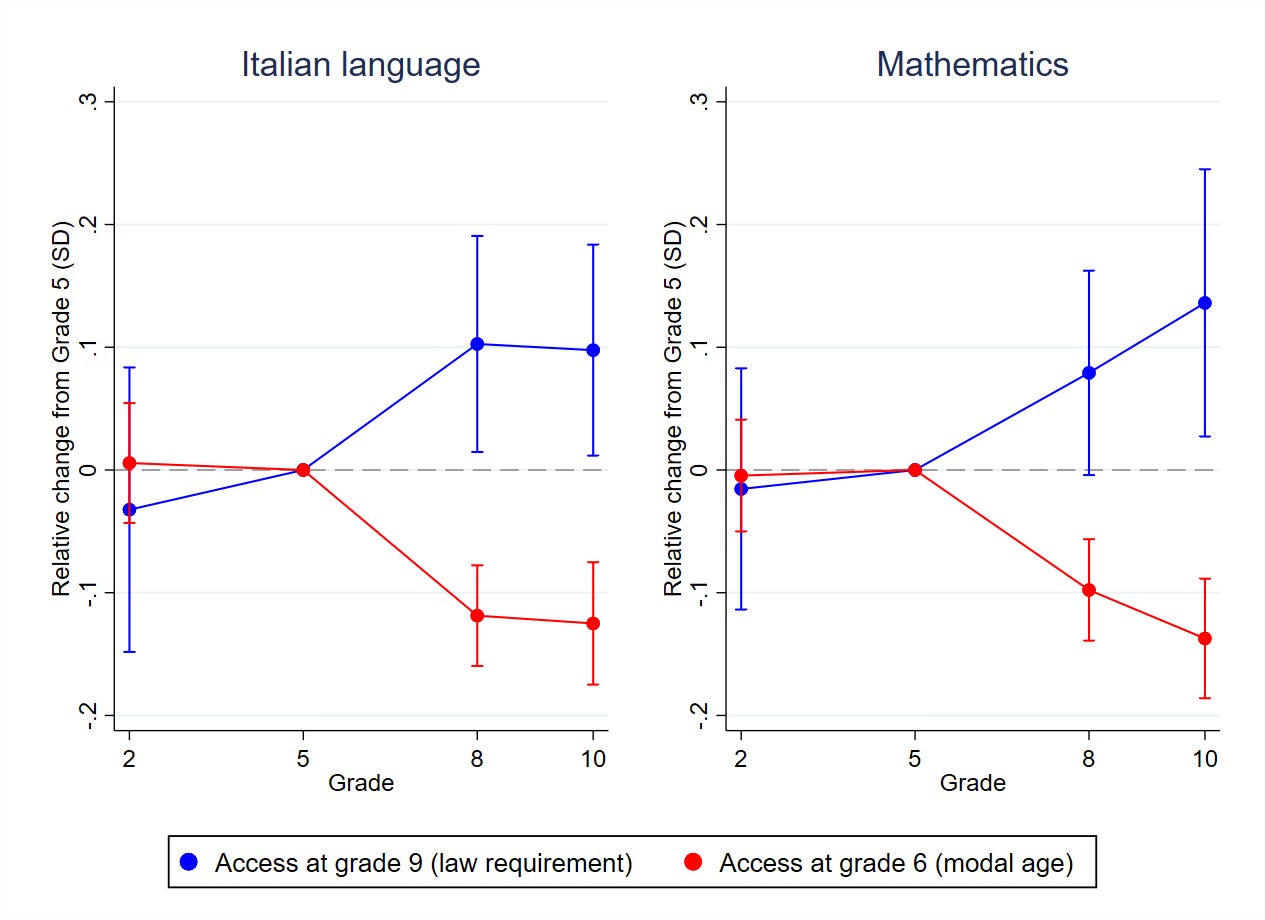
The results show that students exhibit a similar learning trajectory until fifth grade, but then diverge significantly: the competencies of students that access a social media platform earlier lie below the level of their non-exposed peers by about 0.2 standard deviations in eighth grade in both subjects. By 10th grade, the gap in Italian has remained stable, while it has intensified in mathematics.
By the standards of the education literature, the gap we detected is noteworthy. For comparison: in our sample, the average differences in performance in eighth grade between male and female students in mathematics is 0.19 standard deviations in favor of males. The negative effect of early social media use was about as large as this gap, one of the best-documented and most discussed in educational research.
While our data allowed us to estimate credibly IF social media use has an impact, it could not tell us WHY, that is, we could not pinpoint the specific mechanism driving the results. We could, though, test potential mediators that may help explain it. Among them, the strongest predictor was a measure of “smartphone pervasiveness” — a scale capturing how frequently young people use their smartphones during key personal and social moments of everyday life, such as while studying, during family meals, while playing sports, or overnight. This finding suggests that the problem may lie in the continuous fragmentation of attention and the habitual shifting between digital and offline activities. Future research will be able to tell whether this is one of the main mechanisms through which early social media use affects learning.
Unlike mathematics and Italian (students’ mother tongue), we found no evidence that early social media access negatively affected students’ achievement in English as a foreign language. One plausible explanation is that much of the digital content consumed by adolescents — including videos, games, memes, and online interactions — is produced in English, even in non-English-speaking countries such as Italy. Although social media may distract students from schoolwork, it may simultaneously provide incidental exposure to English as a foreign language that partly compensates for these costs.
Some cautionary notes
Combining longitudinal data, matching techniques, and difference-in-differences estimation allows us to move substantially closer to identifying causal effects than traditional cross-sectional analyses. However, no observational study can completely eliminate uncertainty. Our estimation relies on the parallel trends assumption: although we verified that students followed parallel academic trajectories before entering social media, we cannot completely rule out the possibility that unobserved differences emerged later.
Importantly, though, the limitations of our analysis cut both ways: we were voluntarily very restrictive in the definition of social media access; it is not implausible that if future research manages to incorporate the frequent practice of kids doomscrolling with parental accounts, the total effect of social media on competencies could be bigger. On top of that, we have to consider that our estimates are already old: AI-powered predictive algorithms have improved considerably since 2020 (the year in which our early-access cohort began using social media), so we might expect that new design features have since managed to create stronger engagement for users. Future research should also examine other digital environments beyond social media and investigate whether early exposure influences not only academic achievement but also mental health, social relationships, and broader developmental outcomes.
Why does this matter?
Academic achievement is influenced by countless factors. Family background, school quality, teacher effectiveness, motivation, and individual abilities all play important roles. Social media is only one piece of a much larger puzzle. Yet this does not mean its effects are unimportant.
To give another point of reference for our findings, the estimated negative impact of three years of social media exposure is roughly half the average positive effect of one year of intensive tutoring, one of the most effective educational interventions currently available. Our results suggest that the age at which children first gain access to social media platforms deserves much greater attention.
Advocates of “social media freedom” argue that these practices can also enrich young people’s lives, and provide them with opportunities for information and expression. Our research cannot distinguish between types of social media use — e.g., passive consumption versus active engagement — and we cannot rule out the possibility that specific kinds of engagement can also result in positive outcomes for specific subgroups. Our findings simply indicate that, on average, social media use during preadolescence impacts academic outcomes negatively.
An important policy question is whether postponing adolescents’ access to social media can mitigate these negative effects. Our findings suggest that when it comes to academic achievement, it might. This does not imply that delaying access to social media represents a complete solution. But if earlier exposure systematically leads to poorer educational outcomes, then delaying access may provide a relatively simple, low-cost policy response.
However, delayed access cannot substitute for structural interventions addressing the digital environments themselves. If digital distractions account for at least part of the observed effect, as our findings suggest, then engagement-maximizing design features that encourage frequent checking, endless scrolling, algorithmic recommendations, and persistent notifications deserve greater regulatory scrutiny. These design features are not accidental; they are integral parts of the platforms’ business models. If early exposure to these environments carries measurable educational costs, societies may reasonably ask whether platforms should face stronger obligations when their products are used by children and adolescents. Importantly, evidence suggests that these same design features are also problematic for adults, indicating that the underlying mechanisms are not unique to childhood or adolescence.
Finally, it should not be overlooked that effective digital education, grounded in a solid foundation of traditional skills, represents another essential component of a broader policy response. We believe that delaying minors’ access to social media could also provide educators with sufficient time to develop and deliver this preparation in a gradual manner, tailored to the developmental needs of different age groups.
Taken together, our findings suggest that delaying access, improving platform design, and strengthening digital education should be viewed as complementary rather than alternative policy responses.
As societies around the world debate how children should grow up in the digital age, the question is no longer simply whether social media affects young people. It is also when those effects begin — and whether giving children a little more time to develop their cognitive and digital skills before entering these platforms could make a meaningful difference over the course of their lives.


I'm not a social scientist. I'm a middle school teacher. Based on my own anecdotal experience, I would reckon that social media is having a profoundly deleterious cultural effect that is difficult to measure and is collective rather than simply individual (and pscyhological symptomatic). There has never before been a human culture in which the young were allowed to exist in their own ideational spaces in this way, deluged with information and ideas and images and emotions crafted by manipulators and groomers and antisocial actors and profit seekers.
One of the kindergarteners in my school had incest domination porn on his iPad. A 3rd grader had BDSM material. If you're interested in the type of school I teach at you can subscribe to my Substack (or read my most recent post) but that should barely matter. Kids shouldn't be marinating in this content. As a formerly antisocial, impulsive, addiction-prone boy myself I know that this new technological landscape would have ruined my life. I have very little doubt. Where are the adults? As teachers we can't intervene. Parents won't. The bureaucracy (counselors, psychologists, healthcare providers, social workers, etc.) doesn't seem to be too concerned by it all. Perhaps it's just anticipating the wave of dysfunctional clients to come (which means resources and career advance and budget increases and public credibility). Just give it 5-10 years...
https://jmpolemic.substack.com/p/the-maelstrom
Ultimately it’s upon the family to restrict access and passwords.