


Around the world, something has gone badly wrong with student learning. The latest results from PISA, the triennial international assessment of 15-year-olds that came out last week, found the lowest average performance ever recorded across OECD countries in reading, mathematics and science. Learning loss from the COVID-era school closures cannot explain the full story: in many countries, student achievement began declining years earlier. Not only does it not rebound after the COVID years, we don’t even see a slowdown of the decline. So what on earth is happening to the world’s students?
Trends in Performance Over Time in Science, Reading and Math (OECD Nations)
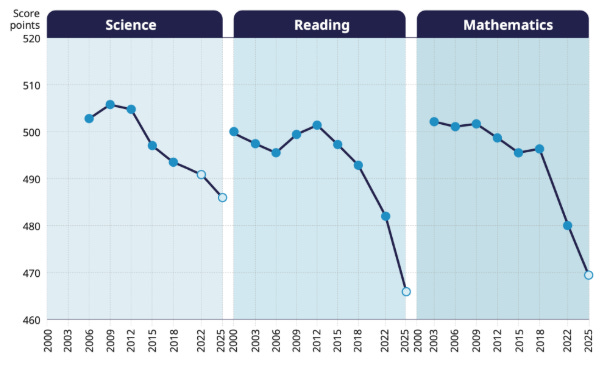
There is almost certainly no single cause, and there will be no single solution. But the timing and nature of the decline give us some clues about where to look for major contributors. The first clue is found by asking: when exactly, did the decline begin? Across many countries, educational performance began deteriorating during the mid-2010s and continued downward across successive testing cycles. The second clue is found by asking: What are students struggling with? Reading performance has fallen the most, especially on questions involving longer texts. The third clue is revealed by asking: How are students feeling about learning? Findings from PISA 2025 show that students have less curiosity to learn new things and less willingness to put in extra effort when school work becomes challenging than their peers in 2022. Even students’ engagement with the testing experience has suffered: the number of students who rush through by giving quick incorrect answers almost doubled between 2018 and 2025.1
One enormous change occurred in childhood and education in many countries over exactly this period: the mass migration of social and educational life onto digital devices. Smartphones became ubiquitous among adolescents, schools adopted one-to-one laptop and tablet policies, scrolling through short-form videos became the central use of social media platforms, and, more recently, students now use generative AI to complete their assignments for them. While none of this proves that digital technologies caused the decline in academic performance, the timing, scale and nature of these changes make them plausible culprits.
In fact, the authors of the PISA report themselves surmise that digital technology is playing an important role:
“We cannot say for sure, but declining levels of reading for enjoyment and the shift towards digital reading – skimming social media feeds and rapidly processing information – may be compromising the ability of students to engage with complex texts and data,” and “This raises questions about whether devices such as smartphones – designed to maximise a user’s attention – are compatible with sustained academic attention.” (p. 6)
Many of these technologies were introduced into schools at enormous scale without much evidence that they would improve student learning — and without an understanding of their potential unintended consequences. It is crucial that we now look closely at these devices and platforms and figure out how they are affecting education.
One way to begin that investigation is to look at what happens when one of these technologies is removed. Rather than trying to settle the difficult historical question of what caused the decline in academic achievement, we can examine a narrower and more answerable question: What happens when schools take phones away from students?
Over the past few years, more than 20 U.S. states and dozens of countries have adopted laws or policies intended to separate students from their phones during school — one of the first large-scale attempts to reverse part of the digital transformation of the school day. This recent and widespread policy shift allows us to examine whether removing access to smartphones improves how students learn, focus, interact, and behave.
Our Investigation
The Tech and Society Lab at NYU Stern just released a new working paper reviewing the available evidence. We focused in particular on natural experiments that allow us to compare what happens before and after schools restrict student phone use. In short, the studies primarily found either beneficial effects or neutral effects, with few negative effects. The effects on test scores were particularly promising (contrary to recent headlines), especially in cases where phone use actually declined in schools.
In our working paper, we summarized what each of the seven natural experiments found, organized by outcome and color-coded based on whether the study found positive (in green), negative (in red) or neutral (in yellow) effects. We encourage interested readers to see the tables presented in our working paper for more detail.
Here on After Babel we’ll share the highlights of the working paper, focusing on three points that we believe have been missed in most of the recent news about phone-free schools. First, recent headlines have centered on one study by Hunt Allcott and colleagues but overlooked some of its important results around positive changes on test scores. Second, other recent studies that found positive impacts on academic performance have received much less attention. Third, schools care about much more than just test scores, and future studies should therefore examine the effects of phone-free school policies on a much broader range of outcomes. Taken together, the evidence suggests that removing phones from the school day is a promising first step in addressing declining student performance and other challenges schools are facing, but it should be considered one part of a broader set of policies and initiatives.
We’ll also share a living review document where we will continue to collect and update the available research on phone-free schools, including on outcomes that deserve more attention.
1. The Evidence on Test Scores From the Allcott Study is Better Than Many Headlines Claim
The Allcott study, which was conducted by an interdisciplinary group of esteemed researchers, examined what happened to students’ academic performance, attendance, discipline incidents and other school experiences when U.S. middle schools and high schools adopted Yondr lockable pouches. The study is extraordinary: it analyzed a nationwide sample of U.S. schools and used multiple sources of data, including GPS data to track student phone use and records from Yondr to track pouch adoption.
Given that this was the first U.S. study of this scale, it has rightly received a lot of media attention since it was posted as a working paper. The media, however, have overindexed on one headline finding: that, overall, phone-free schools have “close to zero impact” on student test scores.
If we base our understanding of the effectiveness of phone-free school policies on this one finding, we miss one crucial issue: This finding is based on effects pooled2 for middle school and high school students, as well as the effects for math and English Language Arts.
This matters because in the study, high school students typically used their phones two to three times more often than middle school students, and twice as many high school teachers said phones were a distraction for students.
Put differently, at least within this study, there wasn’t as much of a “problem” for a ban to fix among middle school students. In-school phone activity fell more, and more consistently, within high schools that adopted Yondr pouches (versus high schools that didn’t) than among middle schools that adopted Yondr pouches (versus middle schools that didn’t). This makes sense: high schools had more student phone use to begin with, and therefore we’d expect to see a larger reduction.
In fact, the authors report that high schools “see modest positive effects, particularly in math, while middle schools see small negative effects” in academic achievement when Yondr is adopted. This “modest” benefit (0.024 student-level standard deviations) on high school students’ math performance is equivalent to roughly one to two months of schooling.3
But that’s not the story most headlines told. The common refrain in the media was that the policies had “close to zero impact.” Compounding the problem, the analyses included more than three times as many middle schools as high schools. In other words, the study found evidence of benefit in high schools (where we know there was a larger problem and we know that phone use dropped) but the overall effect disproportionately reflected results from middle schools (where the problem was smaller and the remedy — phone use reduction — was applied in a lower dose).
As we will show later, many other studies have also found that phone bans or school phone policies have benefited student performance, and as we show in our working paper, the math finding for middle schools in the Allcott study is the only instance, among six studies with similar designs, that found a harmful effect on test scores.
2. Extending the Conversation Beyond the Allcott Study
Allcott et al. (2026) was not the only study published in 2026 on phone-free schools. Two other studies with similar research designs4 were also published this year,5 and one was published in 2025. We have also identified three others that have been published since 2016. (See Table 1 of our working paper for more information on all seven studies, and Table 3 for an overview of the effects on test scores.) What did the other two studies published in 2026 find?
One study, published one month before the Allcott study was posted, was by Abrahamsson, an economist at the Norwegian Institute of Public Health. Using data on which middle schools implemented phone restriction policies and when, Abrahamsson compared Norwegian students’ performance and school experience before and after their school’s ban, for up to four years after implementation.
The results were striking for girls. After a ban, fewer girls sought healthcare for psychological symptoms, fewer reported being bullied, their grades improved, and they were more likely to go on to an academic high school track rather than a vocational one. More importantly, these benefits were even bigger for girls from lower-income families. Boys did not benefit from the policies — apart from reduced reports of being bullied — but they were not harmed by these policies either.
Abrahamsson’s study did not track whether students had indeed used their phones less while in schools as a result of these policies, nor did it look into how the effectiveness of classroom versus full-day phone policies might have differed. The study published one month after the Allcott study, however, did. This study was by Lichand and co-authors. They studied what happened to students’ performance in Math and Portuguese when the city of Rio de Janeiro, Brazil, banned phone use in all its public middle schools.
To figure out whether these bans caused any changes, the researchers compared two groups of schools. In the first group, phones had already been banned before the new citywide rule came in, so the rule didn’t change anything for these students. In the second group, phones had been mostly allowed before, so the new rule was a big change. By comparing what happened to test scores in these two groups, the researchers could see the real effect of enforcing a phone ban. Furthermore, the rollout happened in two stages: first, in mid-2023, phones were banned just during class time. Then, starting in early 2024, the city extended this to a full school-wide ban. This allows the authors to study whether classroom and school-wide bans led to different changes in students’ performance.
The answer is yes. They found that the classroom-only ban barely made a difference. It was only once the ban went school-wide that students performed relatively better on their Math and Portuguese tests, compared to students who were not affected by the ban. The improvement was, according to the authors, equivalent to about one-fifth of a typical year’s worth of learning. Of course, it is possible that the effects of classroom ban simply needed more time to materialize (the study only covers six months of classroom ban data before the school-wide ban took effect), or that the effects observed under the school-wide ban are in fact the delayed effects of classroom ban, or some mix of both. We will need more research to draw a definitive conclusion on this.
Our brief overview here, of the two studies published one month before and after Allcott’s study, shows that media headlines based on Allcott’s study alone are not wholly reflective of the current state of evidence on school phone policies or phone-free schools, which has shown some evidence of benefits for student performance. Even more encouragingly, the recent PISA 2025 findings have shown that students from schools where phones are not allowed on school premises were less likely to be distracted by the use of digital devices in the classroom than students from schools with all other (more lenient) phone policies or no policy at all.
3. Extending the Conversation Beyond Test Scores
While test scores are an important outcome to track, they are not the only important outcome. In fact, many schools implemented phone restriction policies to address the broader disruptions that smartphones, social media, video games and other digital technologies were causing throughout the school day. Teachers and administrators hoped to change the daily experience of school itself: reducing distractions, increasing face-to-face interaction, decreasing bullying and social drama, strengthening teacher-student relationships, improving student well-being, and making school a more engaging place to learn. To understand whether these policies are working as intended, we need to look beyond test scores and consider the broader range of outcomes they are intended to affect.
Fortunately, many of the natural experiments do just that. In our working paper, we organize outcome variables into six categories: (1) phone use in school, (2) standardized test scores, (3) bullying, (4) well-being, (5) disciplinary incidents and (6) other outcomes, like attendance.
There is a wide range of findings across these outcomes, and we recommend reading the full paper for a closer look at each one. (See Tables 2-7 for summaries of each of the six outcomes.) Here, we want to focus on one particularly interesting finding because it illustrates another important lesson about evaluating phone restriction policies: effects can change over time.
Two studies examined disciplinary incidents, and both found that disciplinary incidents increased during the first year of implementation for middle and high schools. At first glance, that sounds like evidence that the policies backfired. But, in both studies, the trend reversed after the first year. By year two or three, disciplinary incidents had returned to baseline or actually declined.
Why? One reason for this reversal is that removing phones creates a temporary adjustment period, where students may initially resist the new rules, teachers may need time to establish new norms around technology use, and schools may temporarily record more violations as they begin enforcing the policy. But as the new norms become established, those disruptions may fade. Another possible reason is that students are interacting with each other more, leading to both additional conflict and louder behavior. It will be important to further examine the specific actions that led to an action being labeled a disciplinary incident. Was it mostly just violations of the phone policy? Or was it an increase (followed by a decrease) in fights and other very serious incidents? There are hints of a similar pattern for well-being, with some evidence of an initial adjustment period followed by more positive effects over time.
What Outcomes Should Be Measured Going Forward?
Even though the natural experiments examined several outcomes beyond test scores, they still measured only a fraction of the changes that might reasonably be expected to occur when phones are removed from the school day.
In our working paper, we identify five broad categories of outcomes that future studies should examine, drawing on anecdotal evidence from news media reports from schools that have implemented the policies. These include: (1) technology use, (2) social interaction, (3) academic experiences and performance, (4) mental health and well-being, and (5) school discipline. For each category, we review why we might expect these outcomes to change and suggest possible approaches to measuring them.
Some of the outcomes we think researchers should consider include:
Technology Use: Phone use declines, student use of other technology (laptops, tablets) in schools. It is vital that every study measures whether the use of smartphones actually declined during school hours. This is what is called an “implementation fidelity check.” If the policy is poorly designed or poorly enforced such that phone use does not actually decline, then there is no reason to expect other outcome variables to show any benefits. It is also vital to measure usage of school-provided laptops to find out whether students are simply switching from their phones to their laptops to watch TikTok and play video games during the school day.

Image. Example news coverage. Modan (2026). Social Interaction: Noise levels, physical activity, face-to-face conversation frequency, playing analog games during lunch or free periods, school spirit, friendship quality. This is the most frequent report we hear from teachers when schools go phone-free.

Image. Example news coverage. Cook (2018). Academic Experiences and Performance: Grades and standardized test scores, classroom engagement, library book checkouts, student-teacher relationships. Standardized tests are not the only measures of academic progress. If students read more books, that is a good outcome in itself.

Image. Example news coverage. Graf (2026). Mental Health and Well-Being: Loneliness in school, subjective well-being, anxiety and depression, teacher stress and burnout, teacher job satisfaction.

Image. Example news coverage. Prothero (2025). School Discipline: Physical fights, overall disciplinary incidents, cyberbullying, bullying, suspensions, school attendance.





While some of these measures may seem unconventional, if phone-free schools are intended to change what students actually do during the school day, then researchers need measures capable of capturing those changes. Test scores and general well-being cannot tell us whether students are talking to one another more, moving around more, forming stronger friendships and reading more books, or whether teachers find their classrooms easier to manage.
4. A Living Review of the Evidence
While our working paper reviews all of the recently published natural experiments we could find, the evidence base will continue to grow rapidly. Tens of thousands of additional schools around the world are adopting phone-free policies, new studies will be published, and journalists will continue documenting what students, teachers and administrators are experiencing on the ground.
To address the pace of new research and evidence, we are cataloging this expanding literature and are publishing it today as a public resource. It brings together empirical evidence on all sides, case studies from schools that have implemented phone-free policies, state and national policy developments, and media coverage on how these policies are playing out in practice.
The document, titled “The Effects of Phone-Free Schools: A Collaborative Review” is a multi-tabbed Google Doc consisting of three main sections:
Tab 1. Evidence on the Effects of School Phone Policies: Empirical studies about school phone policies, surveys of stakeholder groups and news articles about schools that have gone phone-free. This tab goes beyond the natural experiments that are the focus of our working paper.
Tab 2. Evidence on the Effects of Smartphones in Schools on Students: Studies about the effects of using smartphones in schools on students’ academic performance, social interaction and other outcomes
Tab 3. Objections & Responses: Common objections to phone-free schools and our responses to those objections
It also contains three appendices:
This is intended to be a living collaborative document, so if you know of studies, case reports, policy developments or other resources that should be included, please request commenting access via the Google Doc, we’ll grant it, and you can add your comment directly. We’ll continue updating it as new evidence emerges.
Conclusion
Student achievement began declining long before the pandemic. Thanks to the latest PISA report, it is now widely recognized that the reopening of schools as well as the massive adoption of student-used technology in the classroom have not reversed the decline. It has not even slowed it down. The report therefore forces policy makers to search for additional contributors besides the pandemic. While there may be factors unique to each country, the widespread nature of the decline should encourage us to examine factors that had broad international impacts. Rising digital technology use is one leading candidate. It fits the timing well, and it is raised multiple times as a potential cause by the authors of the PISA report.
We do not at present know to what degree these declines are due to the smartphones that appeared in students’ pockets in the early 2010s, or the laptops and tablets that appeared on their desks throughout the 2010s and especially in the first years of the COVID epidemic, or the role that AI is starting to play in the lives of students. But the world is handing us a growing set of natural experiments to study one of these technologies as schools, states, provinces and nations implement phone-free school policies. Many researchers are now stepping up to collect data from sets of these schools and informing us as to whether phone restriction policies alter outcomes in beneficial ways.
Since 2015, PISA has largely been a computer-based test (in PISA 2025, six out of 91 countries still took the tests on paper such as Zambia and Cambodia). As with many computer-based tests, on top of recording student responses to each question, the time students took to answer each question and other data like whether they went back to a previous question, are also recorded.
It is a common practice for academic papers to report a pooled estimate, combining results across subgroups of students or other dimensions (like grade, subject, gender, or over time) to arrive at an overall effect. Some studies, including the Allcott study, also report these results disaggregated since the effects can differ meaningfully across subgroups. Public discussion of any aggregated findings should therefore also consider subgroup-level results, especially when they diverge (as was reported in the Abstract of the Allcott paper for middle and high schools).
According to Hill et al. (2008), an annual math gain in a normal year of schooling (including time in the classroom and outside of it) among high school students averaged around 0.155 standard deviations (SD) across grades 9 to 12. (The gain tends to be lower for older grade students. See Bloom et al., p. 46.) Put differently, in a normal year, even without any intervention, high school students gain about 0.155 standard deviation in their math performance through schooling and other learning that happens over that year. So, the per-month gain is 0.155/12 = 0.013 SD. The Allcott study found that the average effect of the Yondr pouches on high school students’ performance is about 0.024 student-level SD, which is the equivalent of roughly two months of learning. If we exclude the yearly learning gain of grade 12 from the calculation (since there is barely any growth from grade 11 to 12, according to Bloom et al.), the annual gain averages 0.203 SD, translating to 1.4 months of schooling.
Natural experiments.
The Allcott study and two other studies published in 2026 (the papers by Abrahamsson, and by Lichand and co-authors) are all preprints at the time of writing this post.
I would suspect that just examining the use of smartphones by the students is insufficient to explain the results, because it misses other critical factors. As the post alludes to, but doesn’t explore, the use of individual screens (laptops, tablets) in class must surely be important, not just if kids watch Tik Tok on them, but because gamified learning platforms emulate the social media experience by design. Furthermore, teachers nowadays rely on short videos to teach, replacing their natural spoken explanation with visual elements drawn on the blackboard. Finally, surely there must be an enormous impact that screen-addicted parents have on their children, which is completely ignored by these studies and (only instinctively) I’d say may dominate the effects completely. Only studying the whole picture will probably reveal how harmful this new world is to human knowledge, deep thought and critical thinking. Unfortunately designing studies to address this seems extremely challenging, but I think highly worth the effort.
Lots of science. Something I'm sure of; phone free schools work. I'm 73. School had no phones. Engineering school had slide rules. We built rockets, vaccines, and a more just society (for a while, anyway.) Are things better than that now? Certainly more powerful tools.