


Intro by Zach Rausch:
The Anxious Generation is best understood as a three-act tragedy. Act I begins in the mid-20th century, when new social and entertainment technologies (e.g., air conditioning and television) set in motion a long, gradual collapse of local community. Act II begins in the 1980s, as the loss of local community weakened social trust and helped erode the play-based childhood. Act III begins in the early 2010s, with the arrival of the phone-based childhood that filled the vacuum left behind.
This post, written by Andrew Trousdale and Erik Larson, goes deep into Act I. Andrew is a psychology researcher and human-computer interaction designer who is co-running a project on the psychological tradeoffs of progress. Erik is the author of The Myth of Artificial Intelligence, writes the Substack Colligo, and is completing the MIT Press book Augmented Human Intelligence: Being Human in an Age of AI, due in 2026. Together, they show how the isolation we experience today did not begin with smartphones but began decades earlier, as Americans, often for good and understandable reasons, traded connection for convenience, and place-based relationships for privacy and control.
Tracing these trade-offs across the twentieth century, Andrew and Erik help explain the problem of loneliness we face today, and offer some guidance for how we can turn it around and reconnect with our neighbors. Robert Putnam, who read a recent draft, described it as “easily the best, most comprehensive, and most persuasive piece on the contemporary social capital conundrum I’ve yet read.”
— Zach
Scrolling Alone
By Andrew Trousdale and Erik Larson

Americans today accumulate hundreds, even thousands, of Facebook “friends” and Instagram followers. Yet 35% report having less than three close friends and 17% report having none. A quarter of Americans lack social and emotional support. We’re supposedly more connected than ever, but according to the Surgeon General we are facing an epidemic of loneliness and isolation.
It’s tempting to believe that smartphones and social media were introduced to an ideal society and ruined everything. But the social problems we face today — while linked to contemporary digital technologies — are deeper and more nuanced than that. They originated from 20th century technological and cultural forces that also brought extraordinary benefits. It is only by looking back at these benefits that we can see today’s social problems clearly: as the result of trade-offs we have, for decades, been willing to make.
The post-war period in America was a time of enormous economic progress. Between 1947 and 1970, median family income doubled and home ownership soared. This expansion of the middle class brought with it a growing orientation toward mass comfort and convenience as the measure of everyday progress. The dream of labor-saving technology wasn’t new, but the postwar boom made it newly attainable for millions. Innovations like dishwashers, TVs, air conditioning, and remote controls flooded American homes. The Jetsons — with its push-button meals and moving sidewalks — captured an emerging vision for how technology would make life better.
These technologies did free up time, save money, reduce drudgery, and give us more control over our environments. But, as Robert Putnam first posited in his groundbreaking book Bowling Alone, they also disentangled us from one another — eliminating norms and shared experiences that, however effortful, also provided connection. As we grew accustomed to privacy, efficiency, and ease, maintaining our social lives and communities increasingly became a hassle. Independence replaced interdependence. After more than 70 years of making this trade-off, this is the culture we inherited and participate in daily.
The Convenience vs Connection Trade-off
In 1997, John Lambert received a kidney from Andy Boschma, a fellow bowler from his Tuesday night league in Kalamazoo, Michigan. They weren’t relatives. They weren’t even close friends. They just bowled together once a week and that was enough. Putnam opens Bowling Alone with this story because it captures what we’ve been losing: the kind of trust where casual friends would give you a kidney.
Stories like Lambert and Boschma’s emerged from a world of regular, low-stakes, in-person interaction. In 1964, 55% of Americans believed “most people can be trusted.” As Putnam recounts, the average adult belonged to about two organizations. Family dinners were nightly rituals for half of Americans. Dropping by a neighbor’s house unannounced was normal. This was, by Putnam’s measures, the high-water mark of American civic life.
By 2000, when Putnam published Bowling Alone, that world was already disappearing. Trust had fallen to around 30%. Organizational membership fell sharply. He shows that by the 1990s, Americans were joining organizations at just one-quarter the rate they had in the 1960s, and community meeting attendance had dropped by a third. Hosting friends at home fell by 35%.
Four Decades of Dwindling Trust, 1960-1999
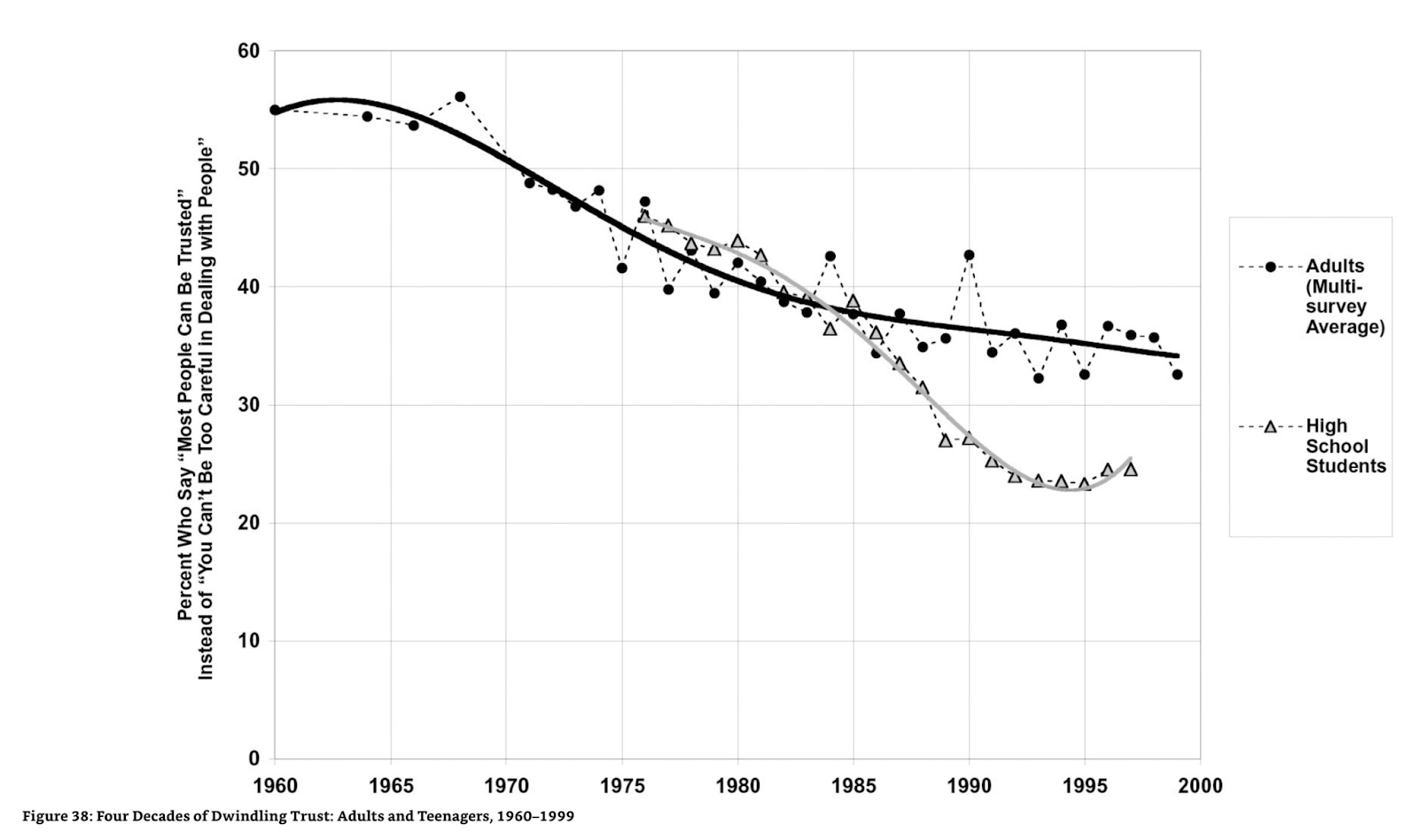
What happened? Starting in the 1950s, America underwent a wave of changes that looked like unalloyed progress. The 1956 Federal Highway Act funded 41,000 miles of interstate, opening up a suburban frontier where families could afford their own homes with yards, driveways, and privacy. Women entered the workforce en masse, expanding freedom and equality and adding to household incomes. The television — which provided cheap, effortless entertainment — was adopted faster than any technology in history, from 10% of homes in 1950 to 90% by 1959, according to Putnam. Air conditioning made homes comfortable year-round. Shopping migrated from Main Street to climate-controlled malls with better prices and wider selection.
These changes were widely embraced because they made life better for millions of people in countless ways. But as Putnam documents, they quietly eroded community, shifting American life toward comfort, privacy, and control, and away from the places and habits that had held communities together.
Suburbs scattered neighbors across cul-de-sacs designed for privacy over casual interaction. The front porch — where you might wave to a neighbor and end up talking for an hour — gave way to the private backyard deck and the two-car garage. Television privatized entertainment, moving what once happened in theaters, dance halls, and community centers into living rooms where, by the 1990s, the average American adult was watching almost four hours a day, and, Putnam tells us, half of adults usually watched alone. Dual incomes often meant neither parent had time for the PTA meeting or volunteer shift. Local shops on main street closed because they couldn’t compete with the mall.
Generation by generation, the habits of connection weakened while the scope of everyday comfort, privacy, and control grew. Then came the digital revolution — with the internet and smartphones — and these isolating forces accelerated.
Digital technology extends the logic of suburban sprawl: it allows us to live not just physically apart, but entirely in parallel. In the past decade, e-commerce jumped from 7% to 16% of retail while physical stores shuttered. Online grocery sales are growing 28% year over year. Home exercise has surged in popularity. Twenty-eight percent of Americans work from home, up from just 8% in 2019. Across every sphere — shopping, working, exercising, socializing — we’re choosing staying in over going out because we enjoy the privacy and convenience.
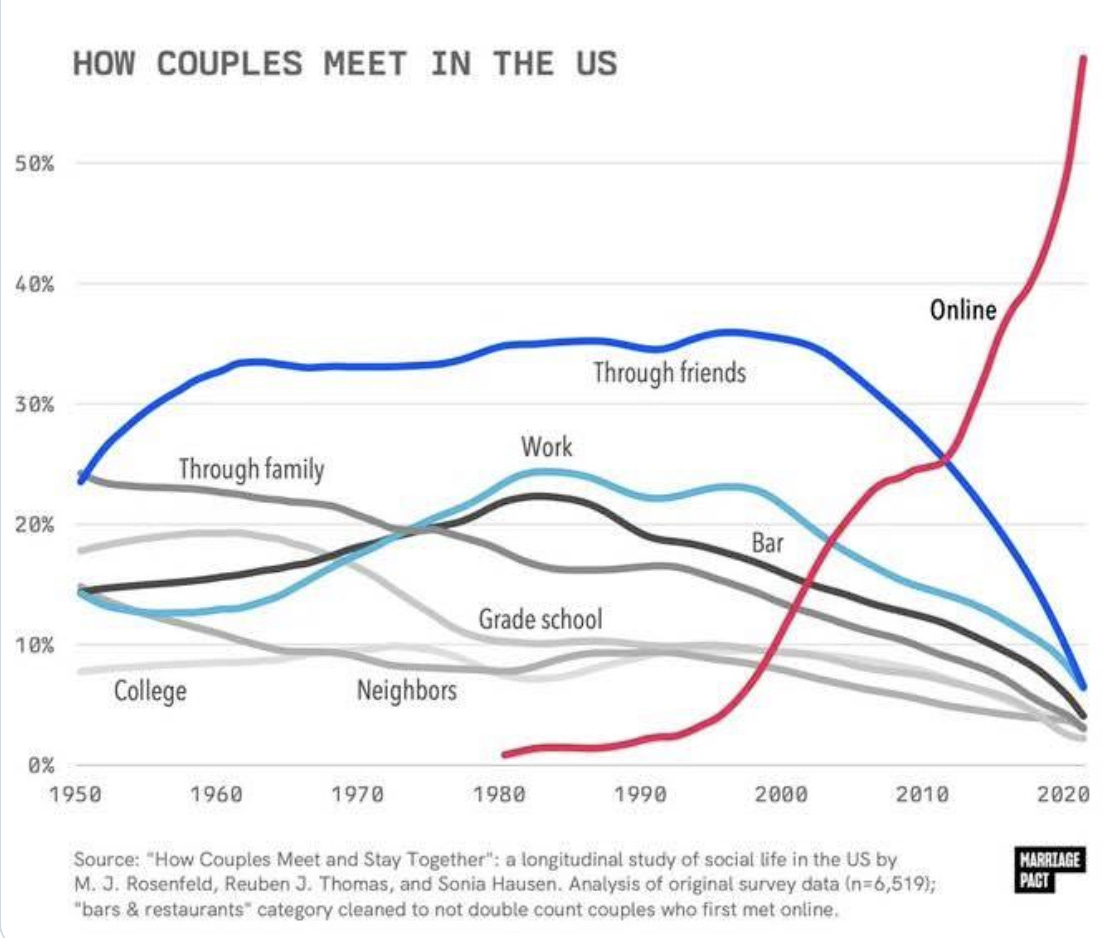
Meanwhile productivity technologies are dissolving the boundaries between work and personal life. While work used to have clear boundaries, today, for knowledge workers in particular, a laptop and Wi-Fi mean the office never closes. Work bleeds into every hour, every room. Microsoft’s Work Trend Index reports that “the average employee now sends or receives more than 50 messages outside of core business hours, and by 10 p.m., nearly a third (29%) of active workers dive back into their inboxes.” More than a third of U.S. workers now do gig work, which offers the freedom to work whenever you want. But when you can always be earning, social commitments become harder to justify. Giurge, Whillans, and West argue that “time poverty” — the chronic feeling of having too much to do and not enough time to do it — is increasing and hits affluent knowledge workers hardest. They use time-saving tools not to free up social or leisure time, but to take on more work commitments. These innovations in how we work make us more productive and create earning opportunities. But they also place a round-the-clock demand on our time. And when we optimize for individual productivity, we sacrifice the shared time — after-hours and weekends — that enables community life.
Workplace innovations are consuming social time and bandwidth, and so are the televisions in our pocket. Putnam found that most of the leisure gains since 1965 have gone to screen-based activities rather than face-to-face social ones. He called television “the only leisure activity that seems to inhibit participation outside the home.” And he argued TV didn’t just consume time, it also rewired leisure from shared experience toward solitary consumption.
Whereas television stays in one room, smartphones are with us everywhere — at bus stops, in waiting rooms, at restaurants, and while “watching” our kids at the playground. Americans still watch 3.5 hours of TV daily in addition to 4.7 hours on smartphones. The internet and smartphones didn’t replace television; they stacked on top, crowding out a mix of other activities. Scott Wallsten found that “a cost of online activity is less time spent with other people.”And when Hunt Allcott randomly deactivated people’s Facebook accounts, they got back an average of 60 minutes per day and spent more of it with people in person. As Netflix co-founder Reed Hastings put it, “we compete with sleep.”
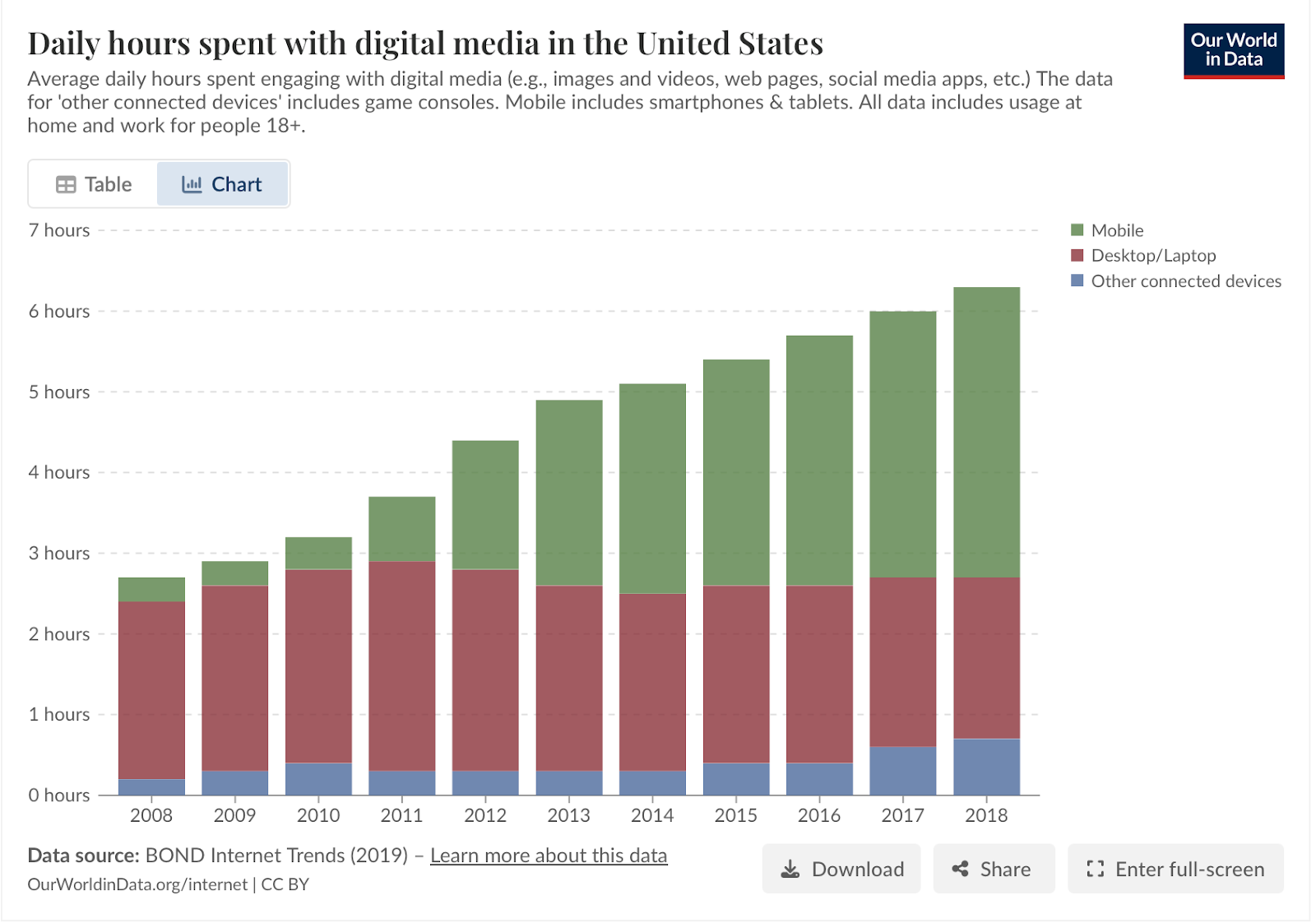
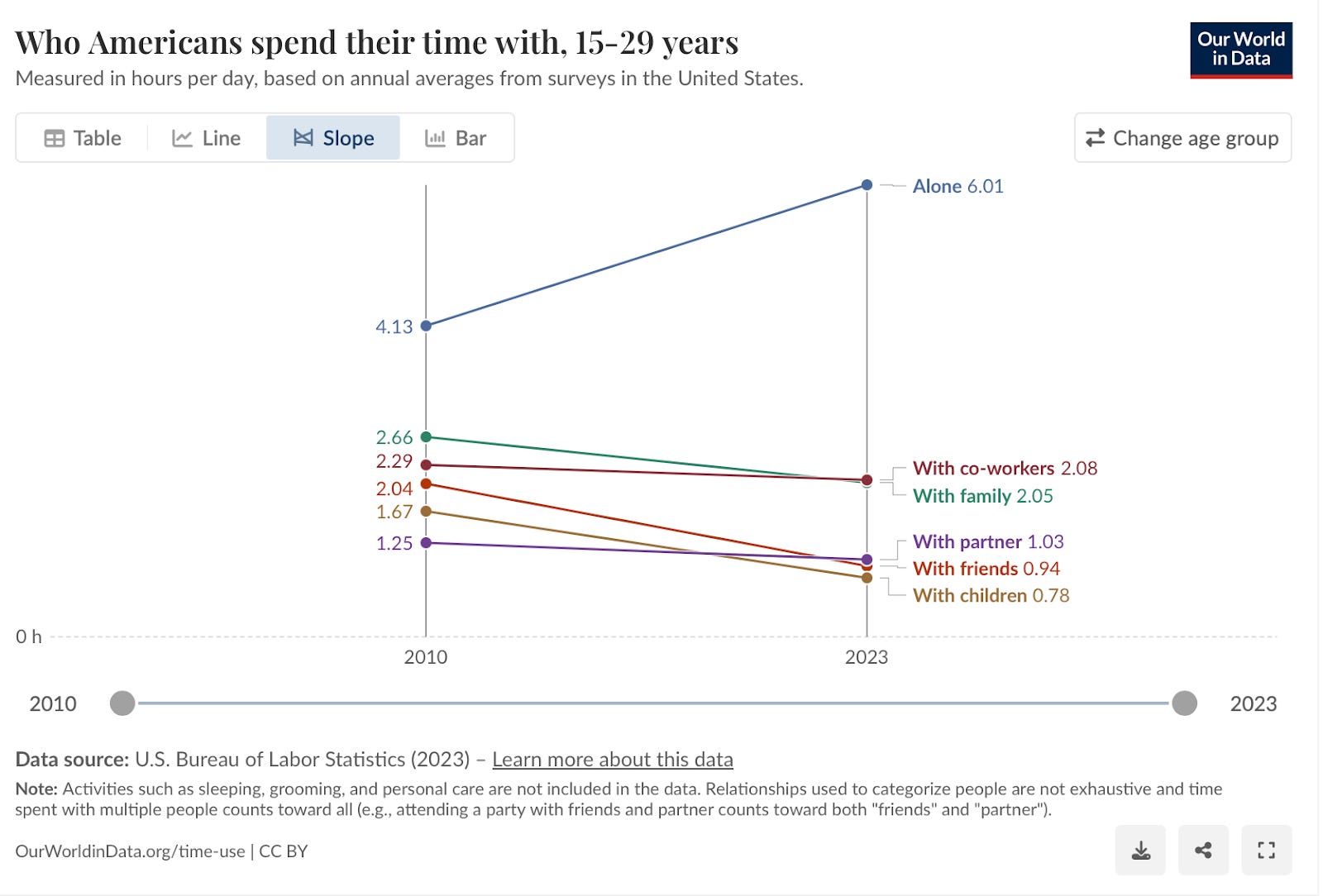
When we spoke with Putnam recently, he said "things are way worse than I thought." Today, only 30% of Americans socialize on any given day. As of 2023, young people spend 45% more time alone than 15 years earlier. Two-thirds of Americans under 30 believe most people can't be trusted. According to Sherry Turkle, even time together with others is compromised by our connected devices, which make us less present to those around us.
There’s a reason these tools have saturated our lives. They save us time, make us more productive, free us from drudgery, engage us when we’re bored, connect us when we’re otherwise alone. But for all that technology can do, it is rarely an adequate substitute for physical presence, shared vulnerability, or the willingness to be inconvenienced for the sake of others.
For better and for worse, we built a world where you can work, shop, eat, exercise, learn, and socialize without ever leaving your home, where work and leisure are increasingly things we do alone in front of screens. In other words, we’ve allowed social interaction to become more optional than ever.
The Path Forward
When we asked Robert Putnam what gives him hope, he pointed to history. In The Upswing, he reminds us that Americans faced a similar crisis before. The Gilded Age brought economic inequality, industrialization, and the rise of anonymous urban life. Small-town bonds gave way to tenements and factory floors. Trust collapsed. By the 1890s, social capital had reached historic lows — roughly where it stands today.
The Progressive reformers found this new world unacceptable, but they didn’t try to turn back the clock. Cities and factories were here to stay. Instead, they adapted, creating new forms of connection suited to their changed reality, from settlement houses for anonymous neighborhoods to women’s clubs that built networks of mutual aid. They didn’t reject modernity; they metabolized it, showing up day after day to create new institutions and communities suited to the industrialized world.
Decades ago Neil Postman observed in Amusing Ourselves to Death that we haven’t been conquered by technology — we’ve surrendered to it because we like the stimulation and cheap amusement. More recently, Nicholas Carr concludes in Superbloom that we’re complicit in our loneliness because we embrace these superficial, mediated forms of connection. Like Postman and Carr, the Progressive Era reformers understood where they had agency when technology upended their world. It isn’t in demanding that others fix systems we willingly participate in, nor is it in outright rejecting technologies that deliver real benefits — it’s in changing how we ourselves live with and make use of the tools that surround us.
There are already signs that people are willing to do this. In a small, three-day survey, Talker Research found that 63% of Gen Z now intentionally unplug — the highest rate of any generation — and that half of Americans are spending less time on screens for their well-being, and their top alternative activity is time with friends and family. And they found that two-thirds of Americans are embracing “slow living,” with 84% adopting analog lifestyle choices like wristwatches and paper notebooks that help them unplug. Meanwhile in Eventbrite’s “Reset to Real” survey, 74% of young adults say in-person experiences matter more than digital ones. New devices like the Light Phone, Brick, Meadow, and Daylight Computer signal a growing demand for utility without distraction.
Unplugging isn’t enough on its own. The time and energy we reclaim has to go toward building social connections: hosting the dinner party despite the hassle, staying for coffee after church when you’d rather go home, sitting through the awkward silence, offering or asking for help.
Ultimately, we can’t expect deep social connection in a culture that prioritizes individual ease and convenience. Nor is community something technology can deliver for us. What’s required is a change of culture, grounded in a basic fact of human nature: that authentic connection requires action and effort, and that this action and effort is part of what makes connection fulfilling in the first place.
We can form new rituals and institutions that allow us to adapt to technology, ultimately changing it to our liking. But it starts with the tools we use and the choices we make each day. If we all prioritize the individual comforts and conveniences we’ve grown accustomed to, no one else will restore the community we say we miss. No one else can. If we want deeper relationships and better communities than we have, we’re going to have to put more of our time, effort, and attention into the people around us.
History shows that we can adapt, building communities suited to changing times. The question is: Will we stay in and scroll? Or will we go out and choose one another?


This is an extremely important piece. Found Bowling Alone fascinating, and the parallels are striking. I'm running an experiment right now, going phone free on my commute (two hours each day) to see if it improves my mood. One of the strangest effects has been loneliness. I am surrounded by people - 99 per cent of whom are on their phones - who are in another world. It has been an insight to how I must make my children feel when I'm on the phone at home.
I'm pleased to say that though it has been hard, after five weeks of rewiring the brain, now feeling genuine and overwhelming benefits.
Excellent piece! The historic trajectory of disconnection often goes unexplored in the context of. the current loneliness crisis. Learning to forge commitments in the real world, rather than just focusing on unplugging, will be the first step toward restoring trust and community. My husband Peco and I explored this in our piece "High Fidelity: Bringing Back Commitment Culture"https://schooloftheunconformed.substack.com/p/high-fidelity-bringing-back-commitment. We'll soon be leading our fourth annual Communal Digital Fast coinciding with Lent, focusing not just on fasting from the virtual, but feasting on the real. Thanks for your work!