

This article was originally published on Jean Twenge’s Substack, Generation Tech. We thank Jean for allowing us to share it with our readers.
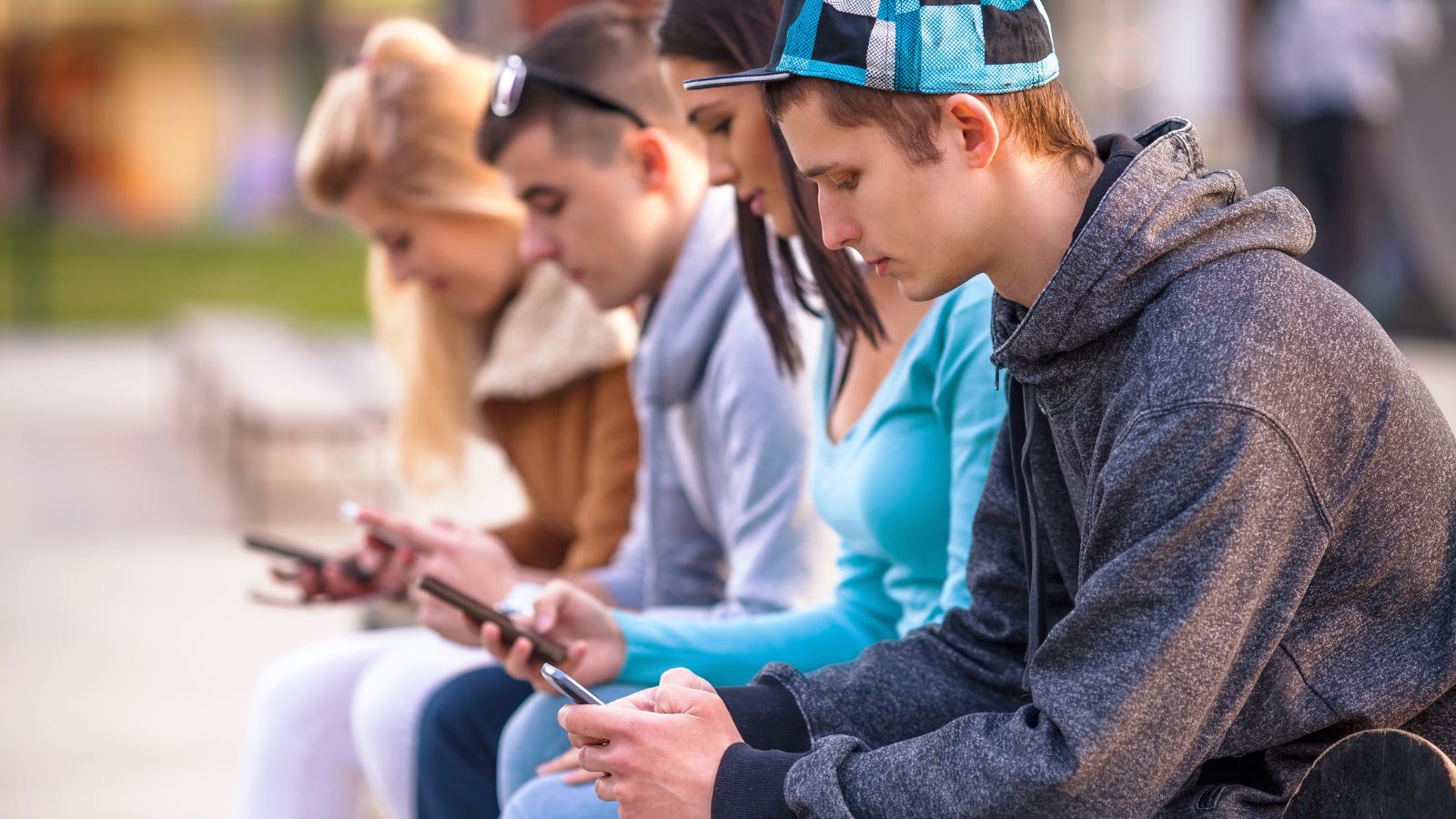
The first evidence we had for the impact of smartphones and social media was for teens’ lives outside of school. Teens were spending less time hanging out with their friends, less time sleeping, and more time on screens, often holed up alone in their bedrooms. That’s not a good formula for mental health, and sure enough, teen depression doubled as smartphones and social media took over after 2012.
But what about during school, where teens spend more than 30 hours a week? Those hours, too, are filled with technology. Sometimes that’s for truly educational purposes — they’re working on an essay for English class, reading a science textbook in an online library, or taking notes in class.
But not always. Even school-issued laptops often allow access to YouTube and streaming (like Netflix, Disney+, and Peacock), allowing students to sit in the back of class and watch endless hours of entertainment. Others play games. Personal smartphones are also a huge distraction: A recent analysis found that American teens spend more than an hour using their phones during the school day, and almost none of that time is spent on educational activities. Instead, teens scroll through social media, watch videos, and play games. Some take videos of their peers without permission, or sneak off to the bathroom to watch TikToks.
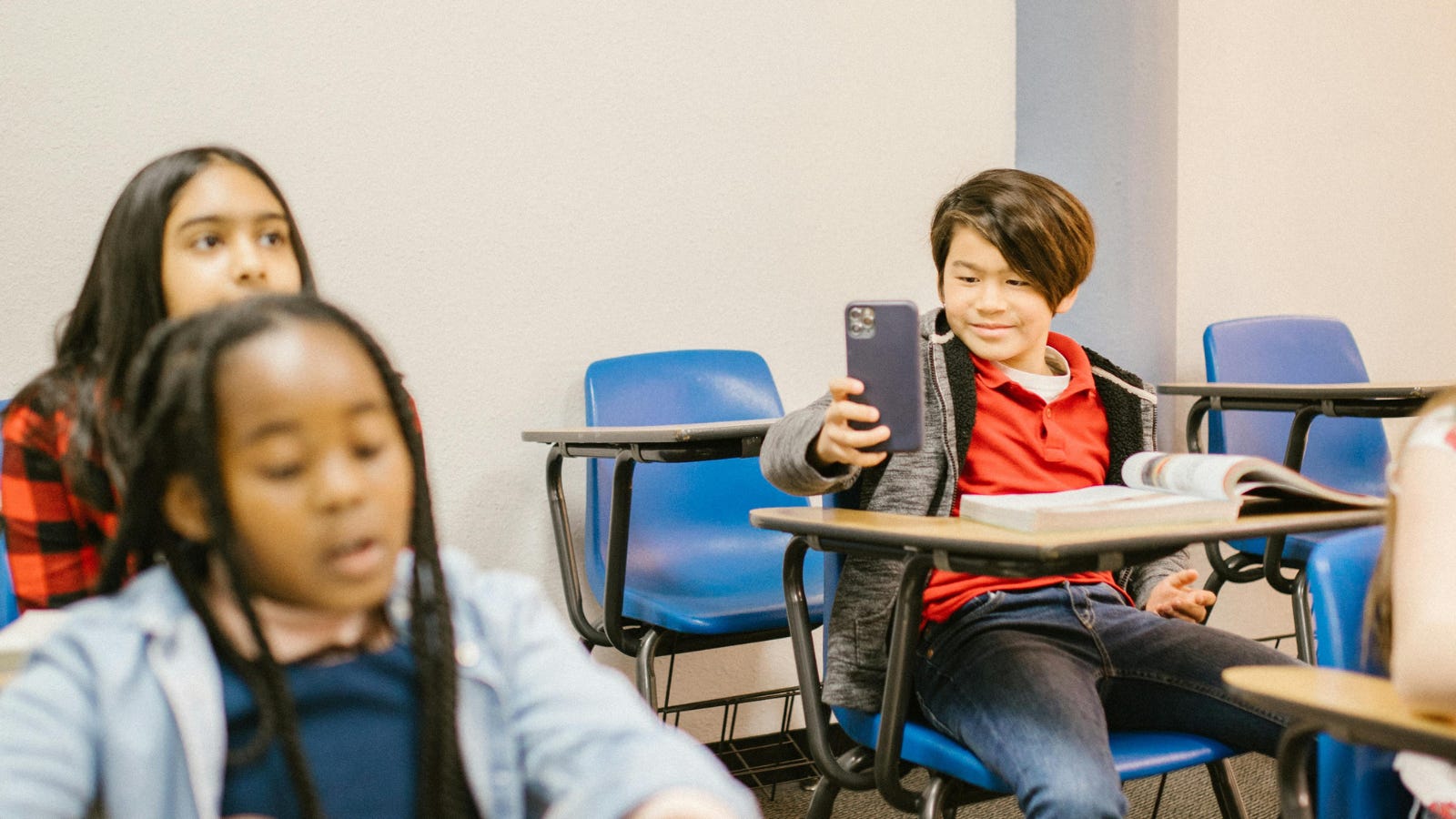
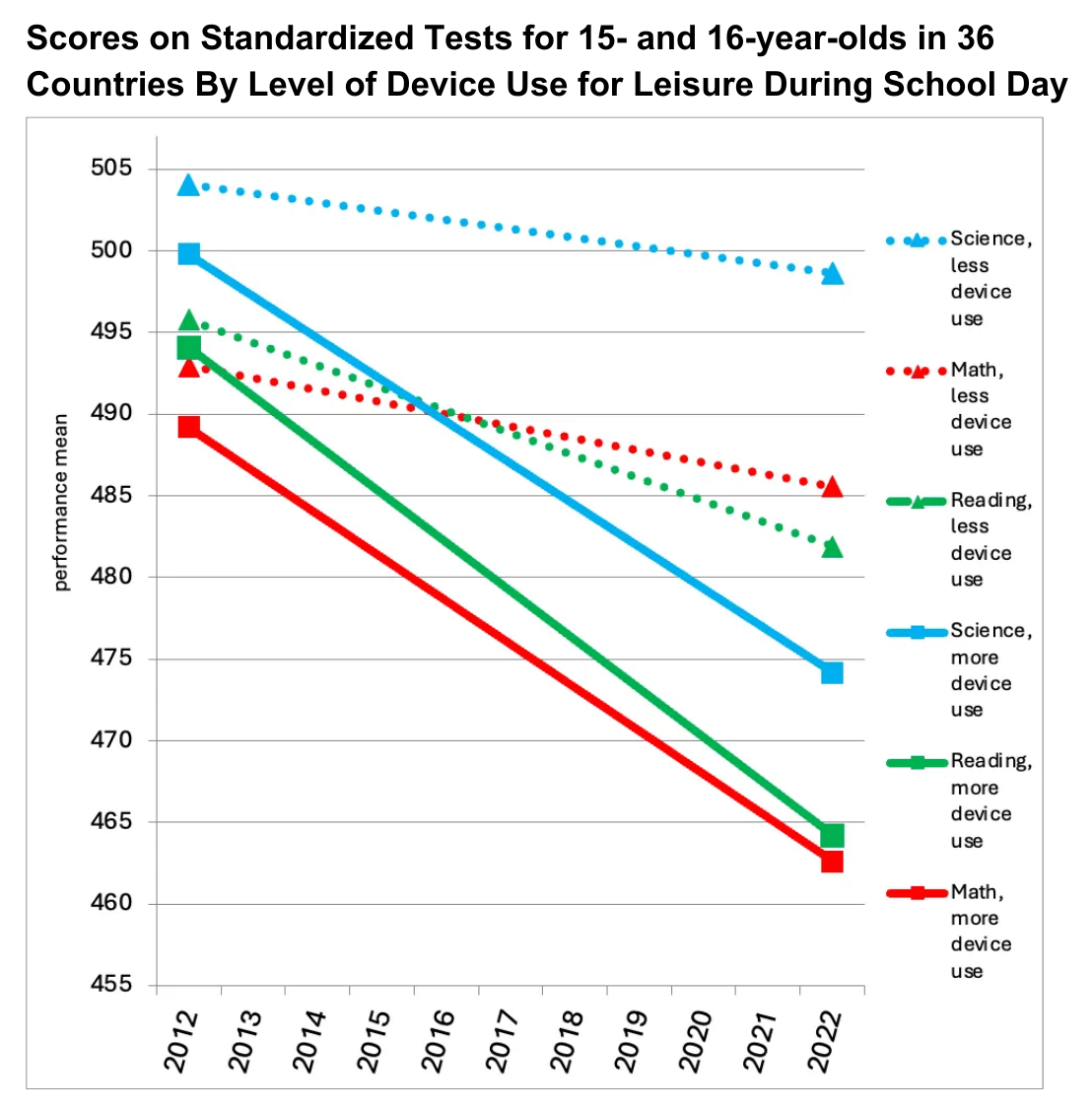
Thus, teens are spending about 20% of their time at school not focusing on schoolwork or talking to their peers. That may be one reason why standardized test scores in math, reading, and science have declined since 2012 and why students have increasingly reported feeling lonely at school. Electronic devices are both distracting in the classroom and isolating in the lunchroom. What impact does that have on teens’ learning and on their mental health?
In a recent paper, my students and I looked into these issues in the PISA dataset of 15- and 16-year-olds around the world. In 36 countries, students consistently took standardized tests in math, reading, and science between 2006 and 2022. In 2022, they were asked how much time they spent using electronic devices (like phones, tablets, and laptops) for leisure purposes (like social media or entertainment) during the school day. This varied quite a bit across countries, with students in some countries spending hardly any time on devices for leisure during the school day, and others spending an average of more than two hours.
In countries where students spent a lot of time using devices for leisure during the school day, test scores plummeted between 2012 and 2022. In countries where they spent less time, test scores merely slid. Thus there was a significantly larger decline in scores in the countries where students spent more time using devices for fun during school hours (see Figure 1).
The consequences of device use aren’t just academic; they are also social and emotional because device use has displaced students talking to each other during lunch and breaks. In countries where students spend more time using devices for leisure during the school day, the percentage of students who agreed “I often feel lonely at school” rose steeply, with the increase much less pronounced in countries with less leisure device use during school (see Figure 2).
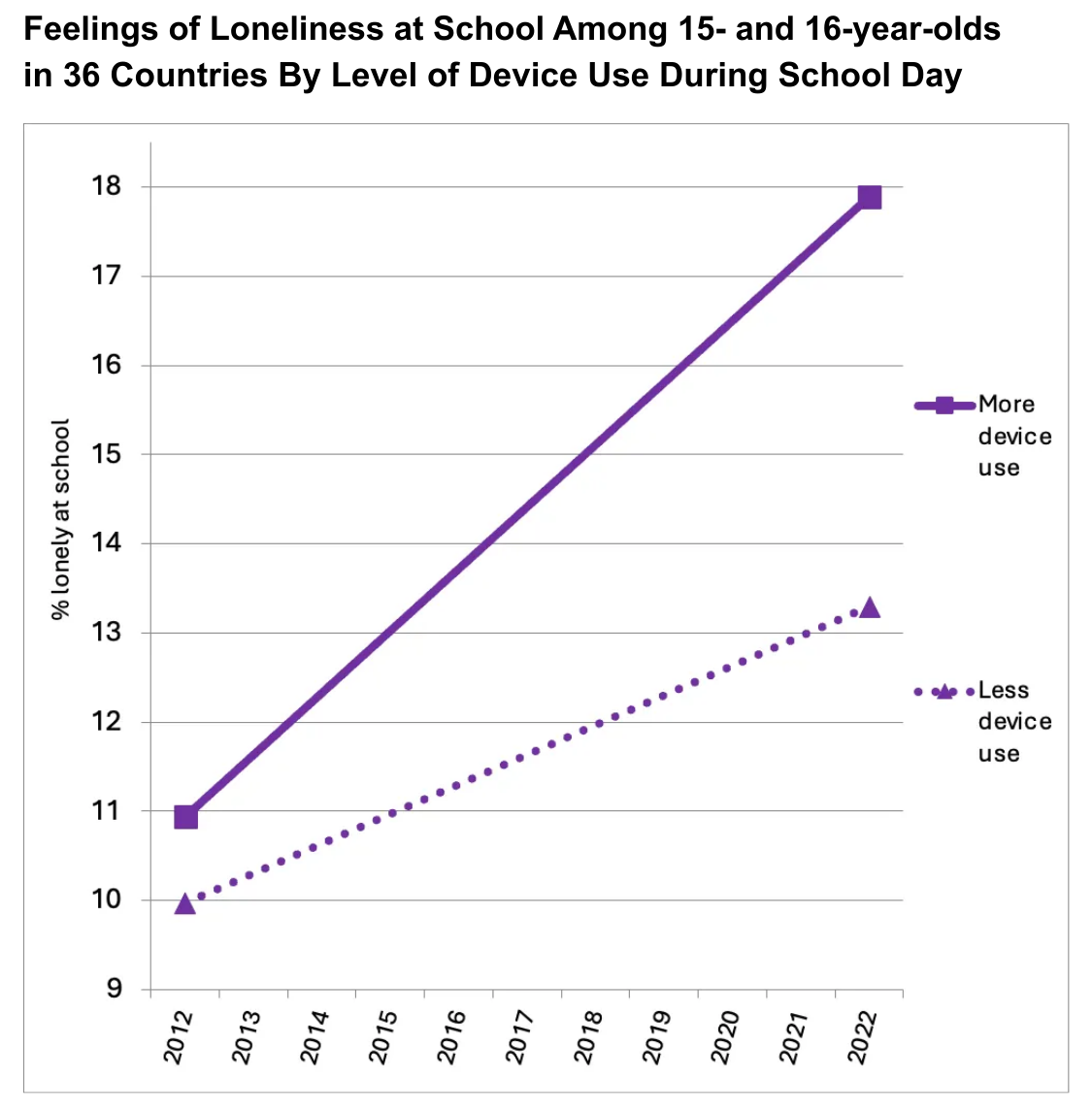
These results show the twin impacts of the leisure use of devices during the school day: declines in test scores and increases in feelings of loneliness at school. They are another piece of evidence suggesting that schools should restrict students’ use of smartphones from bell to bell — not just during class, but also during lunch, breaks, and passing periods. A school where students are talking to each other is less lonely. I recently visited a Milwaukee school with a bell-to-bell no phones policy, and students are now talking, playing cards, and “bedazzling” (had to look that up!) with each other instead of being endlessly absorbed in their phones.
Of course, phones are only part of the problem. The next step is to lock down laptops and tablets so they, too, aren’t being used for social media and entertainment during the school day. Or, especially for younger students, it may be time to go back to paper and pencil — old-school, yes, but with the bonus of no binge-watching YouTube videos during chemistry class. Some states are considering bills outlawing or restricting the use of devices for elementary school students — a welcome step.
Sticking with the status quo means lower test scores and more lonely students — not the outcome any of us want.
P.S. I worked with some truly wonderful undergraduates on the PISA project, which at times seemed endless due to the complexity of the tables (data collected over 22 years across 36 countries). My heartfelt thanks to Spencer Deines, Ellah Fessenden, Lauren Gramse, Julia Lima, Elisa Ruiz, Siri Sommer, and M’Lise Venable.

The anti-social-media brigade has missed the point.
Screens are not the real problem. Social media is not the real problem. They are symptoms of a much deeper failure in how we raise and educate children. Australia’s under-16 social media law is a good example of a political class reacting before thinking, it treats the screen as the cause, when in truth the screen has rushed in to fill a vacuum we ourselves have created. Australia did pass a minimum-age law for social media, and parliamentary scrutiny later also pointed to the need for broader design and duty-of-care reforms, which is precisely the point: the issue is larger than the app.
Children are not born passive. They are born curious. They are born exploratory. They are born wanting to master the world. You see it in a baby learning to walk, falling and trying again. You see it in a toddler throwing food from a high chair, not because the child is naughty, but because the child is running an experiment. You see it in every healthy child who climbs, builds, imitates, risks, negotiates, argues, plays, fails, and returns for more. The natural condition of childhood is not avoidance. It is engagement.
What have we done? We have built a culture that removes struggle from childhood and then acts surprised when children become fragile. We smooth the path, lower the bar, over-supervise, over-explain, over-accommodate, over-diagnose, and then hand children devices to pacify the rest. We have confused comfort with development. But children do not become curious, resilient, brave, or confident by being protected from stress. They become those things by meeting manageable stress, mastering it, and discovering that they can survive it.
That is the real issue. Childhood is supposed to contain friction. Not trauma. Not chaos. Not neglect. But friction. Effort. Waiting. Boredom. Disappointment. Social risk. Physical challenge. Trial and error. The small struggles through which a child learns, “I can do hard things.” Remove that, and you do not produce a safer child. You produce a weaker one.
That is why I do not accept the lazy narrative that social media is the villain and banning it is the solution. A ban may deal with one outlet, but it does nothing to address the deeper developmental emptiness that made the outlet so seductive in the first place. If a child has not been prepared to tolerate boredom, pursue mastery, seek meaning, and enjoy real-world competence, then of course the phone wins. The phone offers stimulation without effort, novelty without risk, and reward without struggle. It is not the cause of the developmental deficit. It exploits it.
We are not preparing children for life. We are preparing them for avoidance. We are not preparing them to be adventurous in mind or character. We are preparing them to seek regulation through external stimulation because we have not helped them build regulation from within. That is why the debate about screens is too shallow. It stays at the level of technology when the real question is developmental.
The proper response is not just fewer screens. It is richer childhoods. More outdoor play. More unscripted exploration. More responsibility. More social negotiation. More mixed-age play. More real challenge. More opportunities to fail, recover, and try again. More environments that build courage instead of dependency.
The question is not whether children should have less social media. Plainly, many should.
The question is why so many children now need artificial stimulation to replace the curiosity, confidence, and resilience that a healthy childhood ought to have built in the first place.
We have not merely given children screens.
We have taken away the struggle. And that is the bigger mistake.
Twenge is describing the surface phenomenon with good data: more leisure technology during the school day is associated with lower test scores and greater loneliness. But in your terms, the deeper issue is not simply that phones are “distracting.” It is that they alter the child’s interostate, fragment attention, reduce opportunities for embodied co-regulation, and keep the nervous system in a state of shallow, externally driven stimulation. What is being displaced is not just academic focus. It is the micro-stress/micro-reward cycle through which children learn to regulate themselves, relate to others, and build autonomy.
A response in your voice could read like this:
Jean Twenge is right to point to the correlation between device use in school, declining test scores, and rising loneliness. But I would go further. The problem with phones in schools is not merely that they distract from lessons. It is that they interrupt the biological conditions required for learning itself.
Learning is not just the transfer of information. It is a physiological process. A child must be in the right internal state before the cognitive systems can come online properly. When a child is constantly pulled toward the rapid, low-friction rewards of a phone, they are not practising sustained attention, social reciprocity, or the toleration of manageable challenge. They are being trained into a different equilibrium.
In the lunch hall, on the playground, and in the classroom, phones displace exactly the kinds of experiences children most need: conversation, boredom, rough-and-tumble negotiation, eye contact, play, conflict resolution, waiting, and the subtle emotional calibration that comes from being with other human beings. These are not peripheral to development. They are central to it.
So yes, phones lower academic performance. But that is only part of the story. They also weaken the child’s access to autonomy, relationship, and regulation. They make the school day less human. And a less human school day is bound to become a lonelier one.
If we are serious about education, then bell-to-bell phone bans are only the beginning. We should also be asking what kind of nervous systems our schools are cultivating. Are we creating environments that promote autonomic flexibility, social connection, and deep learning? Or are we allowing an architecture of interruption to shape the developing mind?
The real question is not whether devices are convenient. It is whether they are compatible with the kind of children, and the kind of society, we want to help bring into being.