

Read Time: 6 minutes
Introduction from Jon Haidt:
Much of the debate about screens in schools has focused on the impacts of specific kinds of content — what is coming into their eyes and ears? There has been less focus on action: What are they doing with their hands? What happens when the hands do little beyond pecking at screens? Today’s post by Zach Schonbrun, author of The Performance Cortex and the forthcoming book Feel, is an important addition to the conversation, exploring some of the damaging impacts of a screen-based school day.
— Jon
What’s Missing in the Screens-in-Schools Debate
By Zach Schonbrun
It’s tempting, in this debate around screens in schools, to frame one side, the greedy Big Tech companies, as encroachers on the sanctity of the classroom. But not all EdTech companies are in league with the devil. Many are trying to make kids smarter, incorporating some of the lessons we know about rote learning and memory formation into programs designed to be more fun and engaging than staring blankly at a distant chalkboard.
Yet, they are still failing. Our kids are not getting smarter. And the disconnect may have a lot to do with how they are physically engaging with the tools of modern schooling.
Teachers and occupational therapists say we are in a crisis of deteriorating fine-motor skills — the ability to nimbly negotiate a pair of scissors, hoist a zipper, or maneuver a pencil. One teacher in Virginia told me of second graders needing her help buttoning their coats. A therapist in Tennessee said she sees 5-year-olds who have never gripped a crayon. A 2018 survey in the U.K. found that nearly half of kids under age 10 couldn’t tie their shoelaces.1
“Pushing keys and seeing letters materialize on screen is a sensorimotor shortcut: It offers plenty of advantages for expediency, but skips key cognitive steps.”
This erosion of dexterity isn’t just a concern for the future of watchmaking. As part of the research for a book I’m writing about touch, I started looking at how our hands are used (or not used) today for a wide variety of tasks. In schools, kids use their hands to write as well as to type. But it’s wrong to assume they’re the same.
Typing is something we all do without thinking much about it, like blinking or yawning. But a feature that makes typing preferable for a broad range of professions — convenience — is what makes it imperfect for education. Pushing keys and seeing letters materialize on screen is a sensorimotor shortcut: It offers plenty of advantages for expediency and consistency, but skips key visuomotor, haptic, and cognitive steps along the well-worn path to literacy.
In fact, a growing mountain of evidence supports the familiar experience that we tend to remember things better if we write them down by hand. One recent review, which considered 30 studies on handwriting vs. typing, was so unequivocal you’d think the authors’ parents were killed by a keyboard. They state, for example, that “handwriting activates a broader network of brain regions involved in motor, sensory, and cognitive processing. Typing engages fewer neural circuits, resulting in more passive cognitive engagement.” At the end of another review — this one evaluating nearly 120 studies — its authors concluded, with almost comical candor, that it was time to move “beyond establishing if links exist” between handwriting and academic performance “to investigating why.”
This, too, is well underway. In the spring, I visited neuroscientist Sophia Vinci-Booher at her lab at Vanderbilt University (she’s now at the University of Notre Dame). Vinci-Booher has been actively trying to challenge the consensus — systematically testing handwriting against practically every activity you can imagine — and failing miserably. She has tested it against typing, against tracing, against watching someone else drawing, against drawing with a pen that doesn’t have any ink. Yet every time, she told me, writing by hand was demonstrably better for identification and recall — the hallmarks of learning. “Producing something, particularly symbols, by hand aids in your ability to recognize them later,” Vinci-Booher said. “It leads to longer lasting recognition.”
“Handwriting activates a broader network of brain regions involved in motor, sensory, and cognitive processing. Typing engages fewer neural circuits, resulting in more passive cognitive engagement.”
Scientists call this “encoding,” which refers to how the brain locks down information long term. Handwriting presents a valuable opportunity for the motor system to work closely with the visual system, producing lines on a paper that the brain has already organized into remembered words or numerals. This engagement helps a handwritten product get encoded more deeply and robustly than one that is typed, Vinci-Booher says.
There are a number of theories on this. Karin James, a psychologist at Indiana University, has emphasized that handwriting is a self-generated action, in which the lines you perceive being created on paper are the outcome of your own motoric self. Her studies have demonstrated that self-generated handwriting engages specific networks in the brain that play a role in letter recognition and reading proficiency that typing alone does not.
Another idea is that handwriting is messy, which counterintuitively can benefit learning. Why would this be the case? Because kids naturally want to get things right. Studies have shown that greater variability in letter formation produces better learning outcomes, likely because of the fact it forces children to think harder about how letters and words should look.2 This is helped by the fact that handwriting is slower than typing, allowing the brain to think more deeply and creatively.
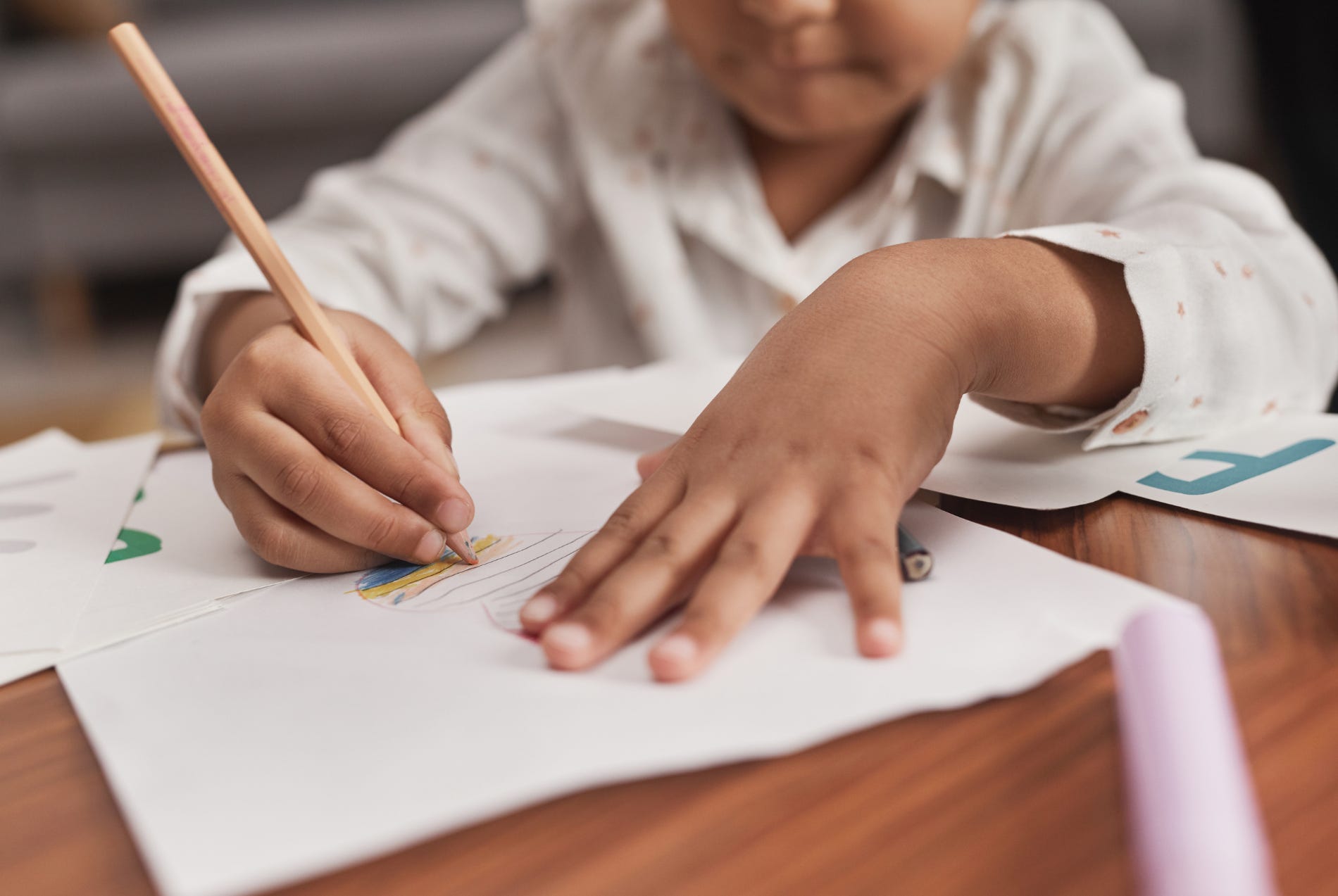
Lastly, it is a physical achievement. The grasp on a pen involves all five fingers in a deceptively simple, cognitively complex dance of firmness and delicacy that activates motor and somatosensory regions in the brain, such that words aren’t just encoded and recalled visually but by the patterns and feeling of their production, too.
Typing on a keyboard involves some, but not all, of these components. Tapping on a screen involves even fewer. “Preschool and kindergarten, especially, they need to be forming letters by hand,” said Vinci-Booher. “They need to have this experience of producing symbols, which helps them learn to recognize letters, which is a critical pre-reading skill.”
Yet most schools have moved away from the boring old pencil. In 1992, a seminal paper in the American Journal of Occupational Therapy found that second-, fourth-, and sixth-grade students spent as much as 60% of the school day engaging in fine-motor activities, primarily handwriting. But a replication study published in early 2020 (just before COVID) reported an alarming retreat from paper-and-pencil tasks: handwriting assumed only 18% of the typical school day for fourth graders, and even less for younger students. It’s no wonder only one out of six teachers believe students leave third grade prepared in sentence writing and handwriting.
“What kids are not doing with their hands is depriving them of opportunities for critical brain development and learning.”
Why should any of this matter? For starters, children learn to experience the world by grabbing hold of it. Touch is the first sense developed in the womb, and any parent will tell you how often an infant will try to grasp any object it can reach. As kids mature, they are still gauging sizes and proportionality — in essence, understanding their little place in a big, big world — by the weights and structures of handheld things. “It’s how you learn about everything,” one occupational therapist told me. “What do things feel like? What’s the difference in size, shape, weight, texture? All those things come through interactions with your hands and the world.”
Relying on our hands is part of what makes us human. Being able to pinch and secure objects between our thumb and another finger — like a pen, for instance — marked a crucial divergence in our evolution from other primates. Our forceful precision grip unlocked a world of finer tool use for our ancestors, and we put it to good use: hunting, cooking, writing, and, eventually, throwing a curveball.
Maybe it is no surprise that, when we turn our backs on millions of years of grip activity, the adverse effects tend to snowball. An EdWeek survey in January found that teachers are seeing a decrease in age-appropriate fine-motor skills in 66% of 5-year-olds and 73% of 4-year-olds. They chalk those deficits up primarily to increased screen time. Problem is, when kids enter the classroom without those fine-motor skills, they seem less inclined to develop them, teachers said, and scissors and markers too often stay in the drawer. This routinely compounds into a less engaged, more fitful academic experience as the children advance.
As I dug into the history of the research on touch, I was surprised to find how big a role tactile engagement has played in pedagogical philosophy in the past. Maria Montessori was such an advocate for hand-based learning that she used to measure the touch sensitivity of children to understand and train their “tactile sense,” linking it to better learning outcomes. “The hand,” she wrote quite decisively in 1907, “is the instrument of man’s intelligence.” Her famous Montessori Method (1909) described a didactic plan that heavily incorporated “tactile education,” down to the specifications of how children should care for their hands and fingernails. “Children must master the language of things before they master the language of words,” believed Friedrich Fröbel, who invented kindergarten. He became famous worldwide for his “gifts,” which became classroom staples in the 19th century, beginning with a simple yarn ball. Frank Lloyd Wright would talk about the influence of Fröbel’s wooden blocks on his architecture, and they became the foundation for a long list of commercial spin-offs, from Tinkertoys to Lincoln Logs to Legos.
The screens-in-schools debate of the modern U.S. school system often focuses on Chromebooks’ impact on mental health, attention, the gamification of education, and social collaboration — all valid criticisms. But even if all EdTech apps were boiled down to a simple word processor, educational outcomes would still suffer. The problem isn’t just what kids are seeing. It’s what they’re touching. The tactile richness of their world has been flattened. What they are not doing with their hands is depriving them of opportunities for critical brain development and learning.
We should all be skilled typists and users of computers. But as a good rule of thumb, if you want to lock something into memory, you’re better off writing it down by hand.
Also see this survey in EdWeek, for instance, which found 68% of K-3 teachers say shoe-tying is more challenging for kids than it was two years ago.
The authors explain, “[i]n the case of printing, the child sees the messy, non-stereotypical form of the letter that they are trying to copy, whereas after tracing, the child sees the usual form of the letter. One hypothesis that we have put forth is that viewing these non-stereotypical forms may aid in constructing broad categories of letters that may facilitate letter recognition.” (p. 14)

My 12-year-old granddaughter is home educated. A few weeks ago she made me a beautiful birthday card and inside it was a handwritten letter of all the things she loves about the time we spend together.
I can imagine her asking her mom how to spell certain words, figuring out the line spacing in her head to make it all fit on the card and pausing between sentences to re-read what she wrote. She doesn’t use screens often and her latest acquisition is an Underwood typewriter. We are a family of writers and I think she is learning to get her thoughts on paper in a way that is facilitating the development of her ability to share her thoughts.
I loved this post today.
The anecdotes about second graders who struggle to button coats, who have not used crayons, or can’t tie their shoes are quite concerning. After reading those at the start of the article I was intrigued to understand how the lack of handwriting would strongly contribute to these struggles. Finishing the article I, I don’t see how handwriting would have directly helped. I suspect that those kids were either manipulating the teacher to do stuff for them, or those kids had never been given the opportunity or forced to learn basic skills. The implication is that the parents who would not show their kid how to button their jacket, play with crayons, or tie their shoes are likely also the parents who are not going to take the effort to teach physical handwriting. Likely they just put a screen in the kids hands.