


“A journey of a thousand miles begins with a single step. But if that first step is hard, then you should quit.”
– Attributed to Lao Tzu, except for the second sentence, which was added by some critics of the Australian social media law.
Australia did the world a huge favor by going first. On Dec. 10, 2025, the nation became the first to require that social media platforms prevent children under 16 from creating or maintaining accounts. Much has happened since the law took effect, and critics have been quick to declare it a failure. But much of the criticism rests on misconceptions about what the law was designed to do, how soon effects should be measured, and what has actually happened so far.
We recently made our case in TIME magazine. We show how the Australian law is already succeeding, and we address five misconceptions about it. With TIME’s permission, we have included the opening of that essay below, along with a link to the full piece.
We’ve also included our detailed analysis of the five studies we found that examine social media use and access among Australian teenagers since the law was implemented. While we had to cut this from the TIME essay because of space constraints, this deeper look further underscores that the law is already showing signs of success.
In short: studies that measured “any use” of any covered platform found relatively small declines (because the law does not prohibit use or access to content), while studies that measured use via an account on specific platforms found much larger declines (which is reassuring, since the law sets an age minimum for account creation and maintenance).
What the World Should Learn from Australia’s Social Media Law
Here is the first paragraph of our TIME article:
Australia’s new social media law took effect on Dec. 10, 2025, raising the age to open or maintain social media accounts to 16. It was a global first. The law called for the biggest social media platforms to do more than just ask for a birthdate. Now, they would be legally required to take responsibility for verifying and enforcing an age minimum.
Half a year on, the world is watching closely. Are the restrictions working?
And here are the five sections of the essay, each of which responds to a distinct misunderstanding:
Multiple studies show that social media use and account access have already declined
Enforcement and compliance will improve over time
Privacy protection is improving
Companies are making their products safer
Better online spaces can now emerge
Our Analysis of the Five Studies Conducted So Far
The below was originally part of section 1 of the TIME essay.
The variation in the data from the early studies of the law’s impact on teens makes a lot more sense after noting the distinction between examining “any use” of the affected platforms and examining “account ownership” specifically. Of the five studies we found, shown in Table 1, the two studies that examined self-reported usage (rows 1 and 2), regardless of account status, found the smallest reductions — 9% and 27% respectively.
In contrast, the survey by eSafety, the Australian regulator (row 4), asked about account ownership for specific services and found drops of 30–36% across Facebook, TikTok, Instagram, and Snapchat. The Molly Rose Foundation (row 5) found that 39% of users ages 12–15 who previously had accounts no longer had an account on any service, with drops of roughly 40–50% for specific services.
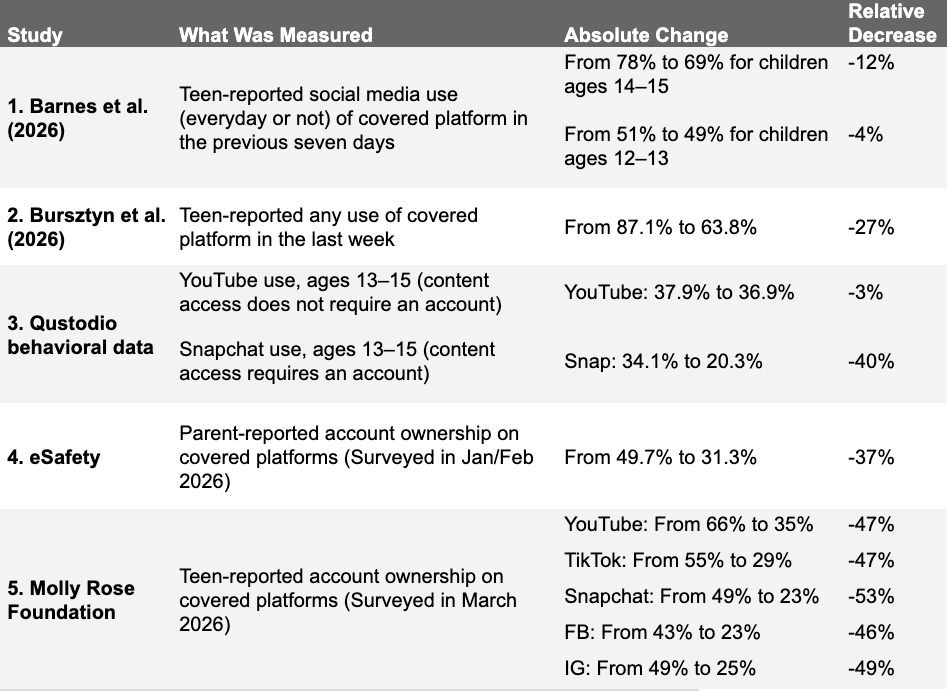
The law’s focus on accounts instead of general use also means that it will affect usage differently depending on the platform. In the study that examined platform-specific use (Qustodio, row 3), YouTube showed relatively small declines in use, while Snapchat showed much larger declines. This difference is likely due, at least in part, to the fact that anyone can access and watch YouTube videos without an account, whereas Snapchat generally requires an account for content access. To accurately measure the law’s effectiveness, studies should look at account creation and maintenance by under-16s on specific platforms, not simply general platform use.
All of these studies reveal that hundreds of thousands of kids are already being protected, because companies are no longer able to provide them with accounts. And this is just the start. It is very difficult to change teen behavior on a national scale. No one should expect the law to result in complete transformation in the first six months.

As Lao Tzu said long ago: “A journey of a thousand miles begins with a single step.” We’re grateful to Australia for taking it.
Cutting account ownership in half is a resounding success, since it is account ownership that is the real mental health / addition / bullying problem.
Imagine you cut teen smoking or drinking by 50% after passing a single law that required no significant police enforcement. Any sane person would say that was a huge success. Yet many of those same people can't admit it here.
The purpose of all of this is to revoke internet anonymity to crush dissenters. The teenage stuff is just window dressing.